
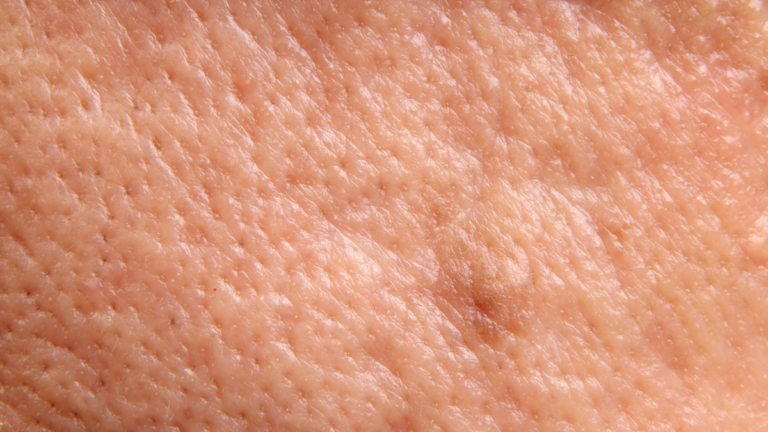

You have been told your skin is dry. You have bought the ceramide cream, the hyaluronic acid serum, the overnight mask. You exfoliate, because that is what you do for rough skin, and for about four hours afterwards it feels smoother. Then the sandpaper comes back. Nothing you apply changes it for longer than an afternoon, and the more you exfoliate the more your face burns.
If that is your pattern, there is a strong chance your skin is not dry at all. It is very likely that what you are feeling is not a lack of water in the skin but something physically standing up out of your pores.
Quick answer
Persistent rough skin texture on the face, with a fine sandpaper feel and mild redness, is the classic presentation of pityriasis folliculorum, the dry form of Demodex overgrowth. Each affected follicle develops a plug of fine scale that protrudes slightly above the skin surface. What your fingertips register as roughness is thousands of these small protrusions, not dehydration. This is why moisturiser produces no lasting change and why scrubbing makes the skin burn without smoothing it. In large clinical series, this dry form is the most common presentation of demodicosis and the one most often misdiagnosed as dry or sensitive skin. Treatment is mite-directed rather than moisture-directed, and texture is the slowest sign to resolve.
What you are actually feeling
Roughness on the face gets treated as a moisture problem because that is the mental model most of us have: rough equals dry, dry equals more cream. For this condition that model is simply wrong, and following it wastes years.
In pityriasis folliculorum, the follicle fills with mites and with the fine keratin scale that accumulates around them. That scale forms a small plug at the follicular opening. Dermatology describes the result as a digitate keratosis, meaning finger-like projections of keratin, and the older literature calls the condition spinulate demodicosis because of those tiny spines.
Run a fingertip across skin covered in thousands of microscopic protrusions and it grates. The sensation is mechanical. No amount of water or occlusive cream on the surface changes a structure that is sitting inside and above the pore.

This also explains the two things that confuse people most.
Moisturiser feels good and does nothing. It softens the very top of the scale for a few hours. The plug is unaffected.
Exfoliation makes things worse over time. Physically abrading the surface knocks the tops off the protrusions, which is why skin feels smoother immediately afterwards. It does not remove the follicular contents, it damages an already inflamed barrier, and it drives the burning and stinging that so often accompanies this presentation.
Why this gets missed
Demodex overgrowth does not have one appearance. It has at least four, and they collect four different diagnoses.

The rosacea-like and folliculitis-like forms get noticed because they are inflammatory and visible. Someone with pustules seeks help. Someone whose only complaint is that their skin feels a bit rough and looks slightly pink is told to moisturise more.
Yet in the largest clinical series, the dry form is the most common one. In a 1,044-patient study using standardised skin surface biopsy, 590 patients had demodicosis, and 445 of those had pityriasis folliculorum. The presentation least likely to be diagnosed is the presentation most likely to be present.
The published case reports show what this costs. One 26-year-old man carried a diagnosis of recalcitrant rosacea for two years with persistent flushing, stinging, itch, blepharitis and a sandpaper texture, having failed metronidazole gel, clindamycin gel, oral doxycycline, vascular laser and isotretinoin, before anyone examined the keratin spicules protruding from his follicles and found the mites. A 38-year-old woman was managing three years of what she believed was rosacea with moisturiser and mild soap.
How rough skin texture from Demodex differs from other causes
Not all facial roughness is mite-driven. These features point toward Demodex.
It concentrates in the oil-rich central face
Cheeks, nose, nasolabial folds, chin and forehead. Genuine dryness tends to be more diffuse and often worse on the outer face. Mites live where sebaceous glands are densest.
There is a background of faint redness
Not the vivid flush of vascular rosacea, but a persistent dull pink that does not fully settle. Pure xerosis is usually pale.
Burning and stinging rather than itch
Products that never used to bother you now sting. This is a common early complaint and often precedes any visible change.
It does not respond to moisture
Genuine dryness improves substantially with a good barrier cream within a week or two. This does not. If you have used a well-formulated moisturiser consistently for a month and the rough skin texture is unchanged, moisture was never the problem.
It is worse in the morning
Many people notice the grain is most obvious on waking and softens slightly through the day. Mites are photophobic and move to the follicular opening in darkness, travelling at roughly eight to sixteen millimetres per hour, so overnight activity concentrates material at the surface. This is also why night-time application of a mite-directed treatment makes sense.
It may follow steroid use
In a 2025 dermoscopy series, six of eleven confirmed cases had a history of corticosteroid misuse. If your texture problem began or worsened after using a steroid cream on your face, read our guide to steroid-induced Demodex, because the driver may still be active.
Other conditions worth excluding
Keratosis pilaris produces the same sandpaper feel but favours upper arms, thighs and cheeks in a symmetrical pattern, typically from childhood. Trichostasis spinulosa produces dark follicular plugs containing tufts of vellus hair, usually on the nose. Both are distinguishable on close examination.
How it is confirmed
Two methods matter, and the difference between them explains a lot of false reassurance.
Dermoscopy is quick and requires no laboratory. The specific signs are Demodex tails, described as creamy or gelatinous threads one to three millimetres long protruding from the follicular opening, and Demodex follicular openings, which appear as round, light-brown to grey halos. Tails are reported as being seen more frequently in pityriasis folliculorum than in the other forms, which makes dermoscopy particularly useful for exactly this presentation.

Standardised skin surface biopsy is the quantitative method. A drop of cyanoacrylate adhesive on a slide is pressed to the skin and lifted, taking the superficial follicular contents with it, and the mites are counted per square centimetre.
The critical practical point is that one sample under-reads the true population. A second consecutive strip taken from the same site roughly doubles the count of the first, because much of the population sits deeper than a single strip reaches. A single uncleaned sample has been reported at around 55 percent sensitivity. A negative result from one casual scrape is weak evidence of absence. Our guide to testing for Demodex covers this in more detail.
What actually helps
The principle is simple. Treat the follicle, not the surface.
Stop exfoliating. This is the hardest instruction to follow because abrasion produces immediate apparent improvement. Scrubs, brushes, strong acids and grainy cleansers all need to stop for the duration of treatment. Skin in this state has a compromised barrier and each session extends the burning.
Use a mite-directed topical consistently. A case series reported significant improvement with topical ivermectin monotherapy in primary demodicosis, and a published case of pityriasis folliculorum responded to daily ivermectin 1 percent cream with what the patient described as great improvement in skin texture by three months. Other options with acaricidal evidence include tea tree oil preparations and permethrin. The clinical evidence review compares them honestly, including where the evidence is thin.
Treat the whole face, not the rough patches. Mites are not confined to where symptoms are worst. Spot-treating leaves an untreated reservoir that repopulates the treated area.
Give it three months minimum. The life cycle is roughly fourteen and a half days and eggs are the stage least reached by treatment, so multiple cycles must be covered. Texture is the last sign to improve because follicular scale clears slowly even after the mite load falls. Judging success at week four is judging too early.
Support the barrier alongside. A bland moisturiser is not the treatment, but it makes the treatment tolerable and reduces stinging. Use it in support, not instead. Skin that has been scrubbed for years usually needs several weeks of being left alone before it stops reacting to everything.
Plan for maintenance. Relapse is common after clearance, and our guide to Demodex maintenance covers what the relapse data supports.
For practitioners
Pityriasis folliculorum deserves more diagnostic weight than it currently receives in general practice. The Ayres brothers described it in 1961 on the basis of thirty years of clinical observation, explicitly framing it as a commonly unrecognised entity, and the recognition problem has not materially improved in six decades.
The practical diagnostic trap is that these patients often present with a chief complaint of dryness or sensitivity rather than a rash, and are triaged accordingly. Two features should redirect the assessment: burning or stinging on product application in the absence of a true irritant history, and follicular prominence on stretched skin under good light. Dermoscopy converts a soft suspicion into a specific finding in under a minute.
On sampling, remember that Forton’s threshold of more than five mites per square centimetre marks where the normal range ends rather than where disease begins, and that the two-strip criterion of greater than five on the first strip or greater than ten across two strips reached 98.7 percent sensitivity with 95.5 percent specificity. Relying on a single strip meaningfully increases false negatives in exactly the dry, low-inflammation presentation discussed here. Further material is available in our practitioner resources and research section.
Frequently asked questions
Why does my face feel like sandpaper but look normal?
Because the change is at the scale of individual follicles. Fine follicular scale is easy to feel and hard to see, particularly under indirect light. Stretching the skin gently under a bright light often reveals prominent follicular openings that are invisible otherwise.
Can Demodex cause rough skin texture without any redness at all?
Mild cases can present with texture change and minimal visible redness, which makes them even easier to miss. Most cases have at least a faint background pink on close inspection.
Will exfoliating help my rough skin texture?
Temporarily and at a cost. It removes the protruding tips of the scale without addressing the follicular contents, and it damages a barrier that is already compromised, which tends to worsen the burning and stinging over weeks.
How long until my skin feels smooth again?
Expect three months before meaningful texture change and up to six for full resolution. Redness and any bumps improve first. Roughness resolving last is the normal sequence, not a sign the treatment is failing.
Is this the same as keratosis pilaris?
No. Keratosis pilaris is a keratinisation disorder that usually starts in childhood and favours the upper arms and thighs. Demodex-related roughness affects the oil-rich central face, appears in adulthood and is accompanied by burning and faint redness.
Could this be fungal instead?
Malassezia yeast contributes to flaking and scaling on the same oily areas, and the two commonly coexist. Flaking that is greasy and yellowish, rather than a fine sandpaper grain, points more toward the yeast side. Our article on antifungal versus acaricidal shampoos covers where each agent acts.
Where to go next
Take the Demodex quiz if you want a structured symptom review, or read what a Demodex infestation involves for background. If your texture problem started after a steroid cream, our article on steroid-induced Demodex is the more relevant read. To find help, see our practitioner directory.
References
- Ayres S Jr, Ayres S 3rd. Demodectic eruptions (demodicidosis) in the human. Thirty years’ experience with two commonly unrecognized entities: pityriasis folliculorum (Demodex) and acne rosacea (Demodex type). Archives of Dermatology. 1961;83:816-827.
- Dominey A, Tschen J, Rosen T, Batres E, Stern JK. Pityriasis folliculorum revisited. Journal of the American Academy of Dermatology. 1989;21(1):81-84.
- Forton F, De Maertelaer V. Two consecutive standardized skin surface biopsies: an improved sampling method to evaluate Demodex density as a diagnostic tool for rosacea and demodicosis. Acta Dermato-Venereologica. 2017;97(2):242-248.
- Forton F, Seys B. Density of Demodex folliculorum in rosacea: a case-control study using standardized skin-surface biopsy. British Journal of Dermatology. 1993;128(6):650-659.
- Sattayakhom A. Demodicosis imitating acne vulgaris: a case report. Clinical, Cosmetic and Investigational Dermatology. 2022;15:451-456. PubMed
- Ferrari A, Diehl C. Pityriasis folliculorum: response to topical ivermectin. Journal of Drugs in Dermatology. 2017;16(12):1290-1291. PubMed
- Pityriasis folliculorum: a novel therapy for a diagnostically challenging condition. Journal of the American Academy of Dermatology. 2013;69(5):e259-e260.
- Diverse clinical presentations of demodicosis: a clinicodermoscopic study. Journal of Skin and Sexually Transmitted Diseases. 2025.
- Rychlik K, Sternicka J, Nowicki RJ, Bieniaszewski L, Purzycka-Bohdan D. Significance of Demodex folliculorum and Demodex brevis in pathogenesis of dermatological diseases: current state of knowledge. Medicina. 2025;61(4):660.
- Elston CA, Elston DM. Demodex mites. Clinics in Dermatology. 2014;32(6):739-743.
- Segal R, Mimouni D, Feuerman H, Pagovitz O, David M. Dermoscopy as a diagnostic tool in demodicidosis. International Journal of Dermatology. 2010;49(9):1018-1023.
About the author. Marina Ivakhnenko is a functional skin
practitioner who works with Demodex-related skin and eyelid conditions. This
article is educational and is not a substitute for individual medical care.
Do not start, stop or change a prescribed medicine on the basis of anything
you read here. If you are using a topical steroid on your face, speak to the
prescriber before altering how you use it.


