
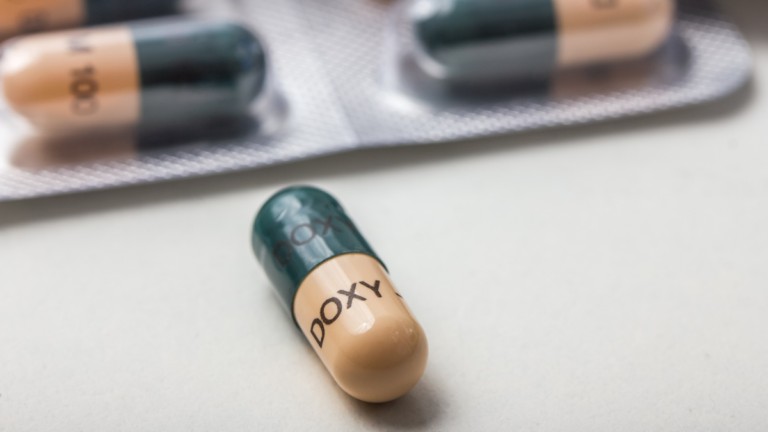

Almost everyone who has taken doxycycline for rosacea describes the same arc. The papules settle over three or four weeks. The face stops feeling hot by the afternoon. Somewhere around month three the prescription ends, and within a few weeks the bumps come back to the same places in the same order. The usual conclusion is that the rosacea is stubborn, or that the dose was too low, or that the body has somehow got used to the drug. None of those is what happened.
What happened is that the medication did exactly the job it was designed to do, and that job was never the whole problem. Understanding the difference is the most useful thing a person with rosacea can learn, because it changes the question from “what else can I take” to “what is still switched on”.
Quick answer
Doxycycline for rosacea is usually prescribed as a 40 mg modified-release capsule, which is a sub-antimicrobial dose. At that dose it is not working as an antibiotic and it has never been shown to lower Demodex mite density. It works downstream, by damping the protease and peptide activity that turns mite pressure into visible inflammation. That is why it clears papules reliably, and why the skin relapses on a predictable timetable after it stops unless the mite side of the picture is addressed separately.
The 40 mg dose is a different drug from the 100 mg dose
This is the part that surprises people. Doxycycline at 100 mg is an antibiotic. Doxycycline at 40 mg, in the modified-release form built from 30 mg of immediate-release and 10 mg of delayed-release beads, deliberately keeps blood levels below the concentration needed to suppress bacteria. The formulation exists precisely so that the antibacterial effect is taken off the table.
The reason is that the benefit in rosacea was never coming from killing bacteria. Tetracyclines have a second, separate set of effects: they interfere with neutrophil recruitment and they inhibit matrix metalloproteinases, the enzymes that sit upstream of the cathelicidin pathway. Those effects appear at doses far lower than antibacterial ones. Stripping the dose back to 40 mg keeps the anti-inflammatory activity and drops the antibiotic pressure on the rest of the body.

The evidence for that design is unusually direct. In a study comparing plasma concentrations against clinical outcome, higher milligram-per-kilogram doses produced predictably higher drug levels and no better clinical result at any visit, with correlation coefficients hovering near zero at weeks 3, 6, 12 and 16. More drug in the blood did not mean less rosacea on the face. Maximum anti-inflammatory effect was already reached at 40 mg.
Why that matters for a long-term condition
Rosacea is managed over years, not weeks. A dose that avoids selecting for resistant flora and produces fewer gastrointestinal effects is a materially different proposition from a course of antibiotics, especially when the person in front of you has already had several. If a clinician has offered 100 mg because the 40 mg formulation is not available locally, that is a reasonable substitution, but it is worth knowing that the extra 60 mg is buying side effects rather than results.
What doxycycline actually reaches inside the skin
The rosacea cascade that this site returns to repeatedly runs in a specific order. Mite density rises in the follicle. Mite antigens and associated debris are sensed by innate immune receptors. Kallikrein-5 activity increases. Cathelicidin is cleaved into LL-37, the peptide that drives vasodilation and the neutrophil influx that becomes a pustule. The visible disease is the last step, and it is several steps removed from the first.

Doxycycline enters at the protease and peptide steps. It is genuinely good there. What it does not do, at any dose, is act on the follicle population itself. It is not acaricidal, it has no antifungal activity, and nothing about its mechanism reduces the sebum supply that the mite feeds on.
The 1993 finding that settles the argument
There is a single old study that answers this cleanly, and it is rarely quoted in patient-facing material. Researchers in Dublin counted mites by standardised skin surface biopsy at six facial sites in 42 people with rosacea and 42 matched controls. The rosacea group carried a mean of 49.8 mites against 10.8 in controls, a large and highly significant difference, with the heaviest density on the cheeks. They then did something almost nobody repeats: they counted again after a one-month course of oral tetracycline.
The counts before and after showed no significant difference. The skin improved. The population did not move. That is the entire thesis of this article in one line, and it was published more than thirty years ago.
A useful contrast is what happens with an agent that does target the mite. Pooled analysis of topical ivermectin studies found mean reductions on the order of 70 mites per square centimetre and roughly an 80 percent drop in the proportion of people above the standard positivity threshold. Isotretinoin, working through a different route entirely by shrinking sebaceous output, has also been shown to lower measured density, with the fall tracking the fall in sebum. Those are drugs that change the first step. Doxycycline is not one of them, and it was never claimed to be.
What the trials show it does well
None of this makes doxycycline a poor medication. The trial evidence behind doxycycline for rosacea is among the strongest in the field. It is one of the better-evidenced options in rosacea and the honest position is that it earns its place.
Two large phase III trials randomised 269 people to 40 mg controlled-release doxycycline and 268 to placebo for 16 weeks. Mean inflammatory lesion counts started around 20 in every arm. At week 16 the active groups had fallen by 11.8 and 9.5 lesions against 5.9 and 4.3 on placebo, differences that were significant in both studies. Improvement was already measurable by the first follow-up visit at week 3, and the curve had still not flattened by week 16, which suggests the benefit continues to accumulate for longer than most courses last.
A community-based trial in people who were already using topical therapy and still symptomatic found that adding the 40 mg capsule brought 75.7 percent to clear or near-clear by week 12. In a 2024 systematic review covering 43 trials and 18,347 patients, doxycycline was the most-studied systemic option in rosacea, almost always at the 40 mg anti-inflammatory dose.
What happens when the capsule stops
The most informative trial is the one that looked at what comes next. People were cleared over 12 weeks on a combination of the 40 mg capsule and topical metronidazole, then randomised to continue on the capsule or switch to placebo for a further 40 weeks.

Relapse was 13.8 percent on continued treatment and 27.7 percent on placebo. Read one way, that is a clear argument for longer courses. Read the other way, it is the more interesting number: even on uninterrupted anti-inflammatory therapy, roughly one in seven relapsed anyway. Suppressing the cascade is not the same as removing what feeds it. That relapse pattern is the same one covered in our guide to Demodex maintenance, and it has the same explanation.
How to sequence doxycycline for rosacea sensibly
The practical conclusion is not to avoid doxycycline. It is to stop asking it to do a job it cannot do, and to run the other half of the plan alongside it.
- Use it for what it is good at. Heavy papulopustular inflammation, a face that is too sore for topicals, or a flare that needs to settle before anything else is tolerable. Onset by week 3 is genuinely useful here.
- Assess mite load before or during, not after. If density is never measured, the relapse will be interpreted as bad luck rather than an untreated variable. The Demodex self-assessment is a reasonable starting point for anyone who has not been tested.
- Run acaricidal support in parallel, not sequentially. The mite generation runs about 14.5 days, which is why our life cycle guide argues for measuring treatment in weeks rather than days. Starting mite-directed care only after the antibiotic finishes wastes the calm window it created.
- Expect the exit to be planned. Stopping an anti-inflammatory with nothing underneath it is the commonest reason a good result unwinds.
- Support the barrier throughout. Skin calmed by an oral agent is still fragile, and an aggressive routine will undo the gain.
Where the presentation is dominated by texture rather than pustules, oral anti-inflammatories tend to underperform, and the reasons are covered in our article on rough skin texture. Where bumps look like ordinary spots that stopped responding to acne treatment, Demodex acne is the more useful frame. If topical therapy has already failed and a prescription acaricide is being considered, our review of permethrin covers what that class does and does not reach.
Where doxycycline for rosacea does not belong
Two situations come up often enough to name. The first is flushing and redness without papules. The trials that established the 40 mg dose measured inflammatory lesion counts, and did not assess people with erythematotelangiectatic presentations alone. Someone whose main complaint is flushing is unlikely to get what they hoped for.
The second is repeated short courses over years. Each course works, each one ends, and the cycle teaches the person that the disease is untreatable rather than that the plan is incomplete. Anyone on their third or fourth course should be asking what has never been assessed rather than what to prescribe next.
Doxycycline is also not appropriate in pregnancy or breastfeeding, or in young children, because tetracyclines affect developing teeth and bone. Sun sensitivity is common enough to be worth planning around. These are decisions for the prescribing clinician, not for a website.
For practitioners
The pharmacology is settled and the clinical gap is a sequencing problem rather than a knowledge problem. Sub-antimicrobial doxycycline achieves its ceiling of anti-inflammatory effect at 40 mg modified release, with plasma concentration uncorrelated to clinical response above that point, so dose escalation is not a rational response to partial benefit.
The mechanistic separation is worth stating explicitly to patients: MMP inhibition and downstream attenuation of KLK5-mediated cathelicidin processing, with no acaricidal activity. Bonnar and colleagues demonstrated unchanged Demodex density after a month of oral tetracycline in 1993, and no subsequent work has overturned it.
Practical implications. First, where density is high, consider concurrent rather than sequential acaricidal therapy, since the 40-week relapse data show 13.8 percent recurrence even on continuous suppression. Second, resist the interpretation that relapse indicates resistance; there is no antibacterial mechanism at this dose for resistance to act on. Third, in patients presenting with erythema alone, set expectations against the trial endpoints, which were lesion counts. Fourth, consider baseline standardised skin surface biopsy, since a documented density gives a reference point for the conversation that follows the inevitable relapse. Further material is collected in the practitioner resources section.
Frequently asked questions
Does doxycycline kill Demodex mites?
No. There is no evidence that doxycycline reduces Demodex density at any dose. The Dublin study that counted mites before and after a month of oral tetracycline found no significant change, while the skin itself improved. Its benefit in rosacea comes from anti-inflammatory activity, not from acaricidal activity.
How long does doxycycline for rosacea take to work?
Measurable improvement in inflammatory lesions appeared by week 3 in both pivotal trials, with lesion counts continuing to fall through week 16 without flattening out. Most people notice fewer new papules in the first month.
Is 40 mg strong enough, or should I ask for 100 mg?
For rosacea, 40 mg modified release is the dose with the licence and the trial evidence. Direct comparison found no additional clinical benefit from 100 mg despite higher plasma levels, so the higher dose mostly adds antibiotic exposure and stomach upset. If your pharmacy cannot supply the 40 mg modified-release form, that is a conversation to have with your prescriber.
Why does my rosacea come back when I stop?
Because the medication suppresses the inflammatory response rather than the trigger that provokes it. In the 40-week randomised phase, 27.7 percent of people relapsed after switching to placebo and 13.8 percent relapsed while still taking the capsule. The step that keeps restarting the cascade sits upstream of where the drug acts.
Can I take doxycycline and use an anti-mite treatment at the same time?
Combination approaches are routine in practice, and the logic of treating the inflammation and the mite load together is sound. The specific agents, timing and monitoring should be set by the clinician managing your care, particularly if you are using other topicals or have sensitive skin.
Will taking it long term cause antibiotic resistance?
The 40 mg modified-release formulation was specifically designed to stay below antibacterial concentrations for this reason, and it has 52-week safety data behind it. That is a different risk profile from repeated antibacterial-dose courses, which is one of the main arguments for the lower dose.
References
- Bonnar E, Eustace P, Powell FC. The Demodex mite population in rosacea. Journal of the American Academy of Dermatology. 1993;28(3):443-448.
- Del Rosso JQ, Webster GF, Jackson M, et al. Two randomized phase III clinical trials evaluating anti-inflammatory dose doxycycline administered once daily for treatment of rosacea. Journal of the American Academy of Dermatology. 2007;56(5):791-802. PubMed
- McKeage K, Deeks ED. Doxycycline 40 mg capsules (30 mg immediate-release / 10 mg delayed-release beads): anti-inflammatory dose in rosacea. American Journal of Clinical Dermatology. 2010;11(3):217-222. PubMed
- Del Rosso JQ, Brantman S, Baldwin H. Long-term inflammatory rosacea management with subantibiotic dose oral doxycycline 40 mg modified-release capsules once daily. Dermatologic Therapy. 2022;35(1):e15180.
- Del Rosso JQ. Anti-inflammatory dose doxycycline (40 mg controlled release) confers maximum anti-inflammatory efficacy in rosacea. Skinmed. 2007;6(4):169-175.
- Del Rosso JQ, Schlessinger J, Werschler P. Effectiveness and safety of doxycycline 40 mg once daily as add-on therapy to existing topical regimens for the treatment of papulopustular rosacea: results from a community-based trial. Journal of Drugs in Dermatology. 2011;10(1):24-30.
- Geng RSQ, Sood S, Hua N, Chen J, Sibbald RG, Sibbald C. Efficacy of treatments in reducing inflammatory lesion count in rosacea: a systematic review. Journal of Cutaneous Medicine and Surgery. 2024;28(2):178-184.
- Paichitrojjana A, Khuancharee K, Paichitrojjana A. Efficacy of topical ivermectin in controlling human Demodex infestation: evidence from systematic review and meta-analysis. Parasite Epidemiology and Control. 2025;e00461.
- Chakmakchi H, et al. Therapeutic modulation of Demodex density via isotretinoin: insights from a prospective dermatological investigation. Journal of Cosmetic Dermatology. 2025.
- Chang YS, Huang YC. Role of Demodex mite infestation in rosacea: a systematic review and meta-analysis. Journal of the American Academy of Dermatology. 2017;77(3):441-447.
About the author. Marina Ivakhnenko is a functional skin practitioner who works with people whose rosacea, folliculitis and blepharitis have not responded to standard care. This article is educational and is not a substitute for individual medical advice. Prescription decisions, including whether doxycycline is appropriate for you, belong with the clinician who knows your history.


