
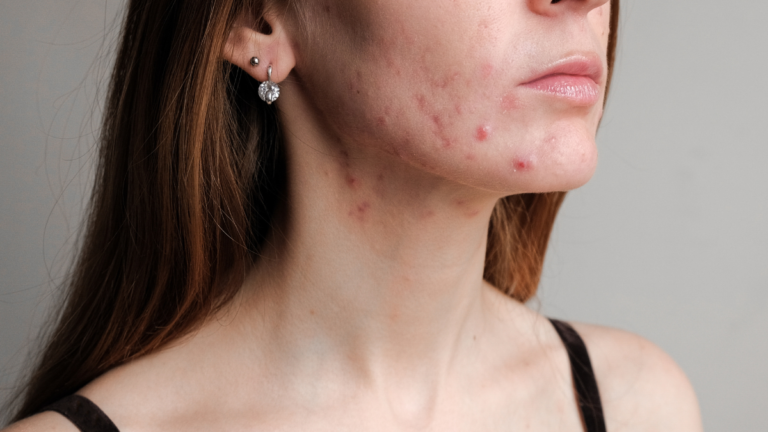

The bloods look better. Cycles have settled. The combined pill or the spironolactone is doing what it was supposed to do, and by every hormonal measure the situation is under control. The skin has not read the report. There are still bumps along the jaw and cheeks, still that gritty roughness under the fingertips, still a face that flushes and stings by mid-afternoon. Being told that skin lags behind hormones by six months is reasonable the first time. By month eighteen it stops being an explanation.
There is a body of research on PCOS and Demodex that speaks directly to this group, and its most useful finding is not the headline one. It sits inside the data, and it points at a different variable from the one everyone is treating.
Quick answer
Two studies have counted Demodex mites in women with polycystic ovary syndrome. Mite positivity was higher in the PCOS groups than in controls, though the larger study just missed statistical significance at p equals 0.052. The more informative result is what happened inside the PCOS group: mite positivity was significantly associated with acne and with oily skin type, and those same associations were absent in the controls. The variable that matters appears to be sebum output rather than the diagnosis, which is why hormonal treatment helps some women’s skin completely and leaves others with bumps that will not clear.
What the PCOS and Demodex research actually found
The larger of the two studies recruited 41 women with polycystic ovary syndrome diagnosed on the revised Rotterdam criteria and 47 women without it, and measured mite density by standardised skin surface biopsy with the conventional threshold of more than five mites per square centimetre.

Positivity was 53.7 percent in the PCOS group against 31.9 percent in controls, with a p value of 0.052. That is a near miss, and it should be reported as one. An earlier study of 30 women with PCOS and 30 matched controls found positivity of 30 percent against 6.7 percent, which did reach significance at p equals 0.04.
So the honest summary is two small studies pointing in the same direction, one of them just short of the conventional cutoff, neither of them large enough to settle anything on its own. Anyone presenting this as established fact is overselling it. What makes the work worth reading is the analysis the authors ran next.
The finding inside the group
Having established the headline comparison, the researchers looked at which women within the PCOS group were carrying mites. Two features came out significantly: the presence of acne, at p equals 0.003, and an oily skin type, at p equals 0.005.

Neither association was present in the controls. That asymmetry is the interesting part. If mite density simply tracked oily skin everywhere, you would expect the same relationship in the control group. Instead it showed up only in the women whose oil production was being driven upward by an endocrine process.
The reading that fits is straightforward. Having PCOS did not predict a high mite count. Having the oily, acne-prone skin that PCOS often produces did. The diagnosis is upstream scenery. The sebum output is the variable the mite responds to. That explains something clinicians see constantly and rarely have a mechanism for: two women with the same diagnosis, the same hormone panel and the same prescription end up with completely different skin.
Why sebum is the variable that matters
Demodex mites live in the pilosebaceous unit and feed on sebum and follicular contents. Food supply is one of the strongest determinants of how large a follicle population can get, which is the reason mite density climbs through adolescence, sits highest in the oiliest facial zones, and behaves differently in skin that has stopped producing much oil at all.
The cleanest demonstration comes from the opposite direction. A prospective study followed 36 patients through six months of isotretinoin and measured mite density before treatment, at two months and at six months. Density fell significantly, and the fall tracked the reduction in sebum secretion at p less than 0.001. Nothing in that drug is acaricidal. It shrinks sebaceous output, and the population falls because the food supply falls.
PCOS runs that same lever in the other direction. Androgen excess enlarges sebaceous glands and increases sebum production, which is why seborrhoea appears in roughly 40 percent of women with PCOS in dermatology series alongside acne, hirsutism and androgenic alopecia. A follicle producing more oil is a follicle that can support a larger population.

The acne that does not track androgens
There is a second piece of evidence that makes this more than a theory, and it comes from mainstream dermatology rather than from mite research. A study of 401 women assessed for suspected PCOS found that acne was more common in those who met the criteria, at 61.2 percent against 40.4 percent. But the authors concluded that hirsutism and acanthosis nigricans were the reliable cutaneous markers of the syndrome, and that acne and androgenic alopecia were prevalent but unreliable markers of biochemical hyperandrogenism.
Sit with that. Within PCOS, acne correlates poorly with measured androgen levels. If the spots do not reliably track the hormone, then normalising the hormone should not reliably clear the spots, and in clinical practice it does not. Something else is contributing in a subset of these women, and mite density is one candidate with data behind it.
What this changes in practice
Not the first-line treatment. Hormonal management of PCOS is appropriate, evidence-based and addresses far more than skin. Nothing here argues against it. What changes is the response when good hormonal control does not deliver clear skin.
- Notice which lesions are left. If what remains is comedonal acne, that is an acne problem. If what remains is uniform small bumps with diffuse background redness, roughness, stinging and burning, that pattern deserves separate assessment. The distinction is developed in our guide to Demodex acne.
- Ask whether density has ever been measured. In most PCOS pathways it has not, because nobody in the chain of care is looking for it. The self-assessment is a starting point, and standardised skin surface biopsy is the clinical test.
- Recognise long antibiotic courses as a signal. Repeated oral antibiotics for PCOS acne with partial or temporary benefit is one of the more common histories in this group. Our article on doxycycline explains why an anti-inflammatory dose can settle lesions without changing what produces them.
- Consider the yeast layer as well. High sebum output supports more than one resident organism, and monomorphic itchy bumps on the chest and back in the same person may be a separate process. Our guide to Malassezia folliculitis covers how to tell.
- Plan for maintenance. If sebum output stays high, so does the carrying capacity of the follicle. That makes this a management problem rather than a one-course problem, in the same way described in our guide to long-term maintenance.
There is a mirror image of this article elsewhere on the site. Our piece on Demodex and menopause deals with women whose sebum output is falling and whose mite-related skin disease rises anyway, which resolves through host immunity rather than food supply. Together they make the same point from opposite ends: sebum is one input among several, and the balance shifts across a lifetime.
What we do not know
Being clear about the limits is part of the value here. The PCOS and Demodex evidence base is two small observational studies, and it should be described that way.
No study has counted mites before and after anti-androgen therapy in PCOS, so the claim that lowering sebum lowers density in this population is an inference from isotretinoin data rather than a direct finding. No trial has tested acaricidal therapy as an addition to standard PCOS acne treatment, so the sensible-sounding conclusion that it would help is untested. Both mite studies were small, observational and conducted at single centres, and the larger one did not reach significance on its primary comparison. The authors themselves framed their conclusion as a hypothesis worth testing, suggesting that anti-Demodex treatment may improve acne response in this group and that further studies are needed.
What can be said is that a plausible mechanism, two consistent small studies, a significant within-group association with the exact skin features that predict mite load, and a large clinical population whose acne does not track their androgen levels together make a reasonable case for assessment. That is a different claim from causation, and it should stay that way until better work exists. The wider evidence picture is set out in our research section.
For practitioners
The clinically actionable finding in the PCOS and Demodex data is the within-group analysis rather than the between-group comparison. In the Eser cohort, D. folliculorum positivity by standardised skin surface biopsy was 53.7 percent versus 31.9 percent, p equals 0.052, but positivity within the PCOS group associated significantly with acne, p equals 0.003, and oily skin type, p equals 0.005, with neither association present in controls. The earlier Turkish cohort reported 30 percent versus 6.7 percent, p equals 0.04.
Interpret that as sebum-mediated rather than endocrine-mediated. The supporting mechanism is the isotretinoin cohort in which density fell in proportion to reduced sebum secretion at p less than 0.001, with no acaricidal mechanism involved. The corollary for anti-androgen therapy is untested and should be presented as such.
Where this alters management. Consider standardised skin surface biopsy in women with PCOS whose acneiform eruption persists despite biochemical control, particularly where the morphology is monomorphic, where background erythema or textural change is present, or where there is a history of multiple antibiotic courses with transient benefit. The JAMA Dermatology finding that acne is an unreliable marker of biochemical hyperandrogenism in this population supports looking for a second driver rather than intensifying the first. Referral pathways and further reading are in the practitioner directory.
Frequently asked questions
Does PCOS cause Demodex overgrowth?
No causal relationship between PCOS and Demodex has been demonstrated. Two small studies found higher mite positivity in women with PCOS than in controls, and one of them did not reach statistical significance. The stronger finding is that within PCOS, mite positivity tracked oily skin and acne rather than the diagnosis itself, which points to sebum output as the mechanism rather than the endocrine condition directly.
Why does my PCOS acne not clear on hormonal treatment?
There are several possible reasons, and one worth knowing is that acne correlates poorly with measured androgen levels in this population. In a study of 401 women, hirsutism and acanthosis nigricans were reliable markers of the syndrome while acne was not, which means normalising hormones does not automatically clear the skin. A second driver in the follicle is one explanation among several.
How would I know if mites are part of my picture?
Suggestive features include bumps that are all a similar size, diffuse redness between the lesions rather than clear skin, roughness or a sandpaper texture, stinging and burning rather than soreness, and a history of acne treatments that helped briefly and then stopped. Confirmation requires standardised skin surface biopsy performed by a clinician.
Will treating Demodex clear PCOS acne?
That has never been tested in a trial, so nobody can promise it. The study authors raised it as a hypothesis worth investigating. What is reasonable is to assess mite density in women whose acne persists on good hormonal control, and to treat what is found rather than assuming the hormones are the only variable.
Does isotretinoin help because it reduces mites?
Partly, and indirectly. Isotretinoin shrinks sebaceous output, and measured mite density falls in proportion to that reduction. It is not acaricidal, so the effect is on the food supply rather than on the organism. That is a useful illustration of why sebum, not the drug class, is the lever.
Does diet or a supplement lower mite numbers in PCOS?
No controlled trial has shown that any diet or oral supplement reduces Demodex density in anyone, including women with PCOS. Nutritional strategies aimed at insulin resistance are worth pursuing for the syndrome itself, and may influence sebum indirectly, but they should not be presented as mite treatment.
References
- Eser A, Erpolat S, Kaygusuz I, Balci H, Kosus A. Investigation of Demodex folliculorum frequency in patients with polycystic ovary syndrome. Anais Brasileiros de Dermatologia. 2017;92(6):807-810. PubMed
- Inci M, Serarslan G, Ozer B, et al. Demodex folliculorum in polycystic ovary syndrome patients. Journal of Infection in Developing Countries or equivalent regional publication. 2015. PubMed
- Schmidt TH, Khanijow K, Cedars MI, et al. Cutaneous findings and systemic associations in women with polycystic ovary syndrome. JAMA Dermatology. 2016;152(4):391-398. PubMed
- Chakmakchi H, et al. Therapeutic modulation of Demodex density via isotretinoin: insights from a prospective dermatological investigation. Journal of Cosmetic Dermatology. 2025.
- Aktas Karabay E, Aksu Cerman A. Demodex folliculorum infestations in common facial dermatoses: acne vulgaris, rosacea, seborrheic dermatitis. Anais Brasileiros de Dermatologia. 2020;95(2):187-193.
- Bonnar E, Eustace P, Powell FC. The Demodex mite population in rosacea. Journal of the American Academy of Dermatology. 1993;28(3):443-448.
- Forton F, Seys B. Density of Demodex folliculorum in rosacea: a case-control study using standardized skin-surface biopsy. British Journal of Dermatology. 1993;128(6):650-659.
- Alkhalifah A, et al. Cutaneous manifestations and hormonal changes among polycystic ovary syndrome patients at a tertiary care centre. 2021.
- Nasution K, et al. Association between Demodex infestation and acne vulgaris with facial dermatitis. 2024.
- Chang YS, Huang YC. Role of Demodex mite infestation in rosacea: a systematic review and meta-analysis. Journal of the American Academy of Dermatology. 2017;77(3):441-447.
About the author. Marina Ivakhnenko is a functional skin practitioner who works with women whose acne, rosacea and folliculitis have not responded to standard hormonal or dermatological care. This article is educational and is not a substitute for individual medical advice. Decisions about PCOS management belong with the clinicians involved in your care.


