
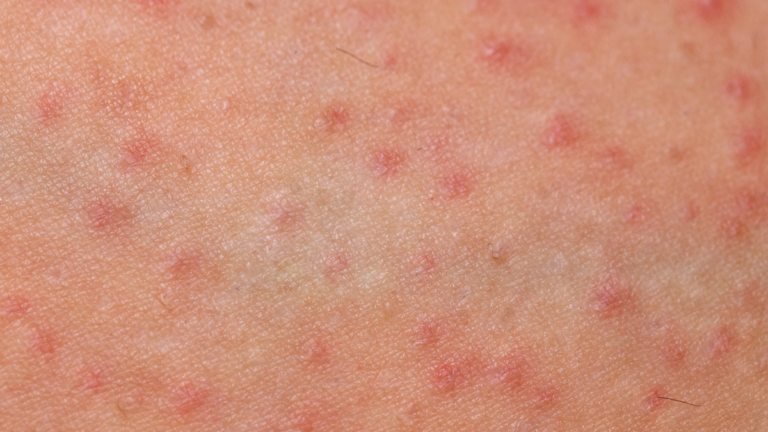

The bumps came up across the chest, the upper back and the hairline. They itched, which was the odd part, because spots are not usually itchy. Two rounds of antibiotics did nothing. A benzoyl peroxide wash did nothing. Then somebody suggested an antifungal, the whole eruption faded in about three weeks, and it felt like the problem was finally solved. Four months later it was back in exactly the same distribution.
That sequence is so consistent that it is close to diagnostic on its own. It is also widely misread. The return is not evidence that the treatment failed, or that resistance developed, or that the diagnosis was wrong. It is a predictable consequence of what these yeasts are and where they live, and once that is clear, the plan changes shape.
Quick answer
Malassezia folliculitis treatment uses topical azoles for two to four weeks, or an oral azole where the eruption is extensive, and the response rate is high enough that failure to improve within four weeks should prompt a review of the diagnosis rather than a stronger antifungal. Recurrence within three to four months of stopping is the norm rather than the exception, because Malassezia is a normal skin resident feeding on sebum that treatment does not change. Long-term control depends on intermittent maintenance, not on a longer initial course.
What this eruption actually is
Malassezia yeasts live on the skin of essentially every adult. They are residents, not invaders, and their presence is normal. Folliculitis develops when the population inside the follicle rises far enough, in the right person, to provoke an inflammatory response. The condition is still often called Pityrosporum folliculitis in older literature and fungal acne online, and all three names describe the same thing.
The organism has an unusual metabolic constraint that explains most of its behaviour. These yeasts cannot manufacture their own long-chain fatty acids, so they harvest them from sebum using secreted lipases. That single fact predicts the distribution, which follows sebaceous density down the chest, upper back, shoulders, neck and hairline. It predicts the risk factors, which are heat, humidity, occlusion, sweating and anything that raises oil output. And it predicts the recurrence pattern, because clearing the yeast does not touch the food supply that supported it.
The diagnostic delay is the real problem
A hospital series of 26 patients found a mean symptom duration of 61 months in people with normal immune function before the diagnosis was made. Sixty-five percent had already been given topical or systemic antibiotics or anti-acne drugs, and those were ineffective in every single case. Direct microscopy identified the yeast in 89 percent, while histology only picked it up in 33 percent, which is a useful reminder that the simpler test is the better one here.
Five years of being treated for the wrong condition is not unusual for this diagnosis. It is what happens when a monomorphic itchy eruption gets classified by appearance rather than by behaviour.
What Malassezia folliculitis treatment looks like, and how fast it should work
European guidance published in 2023 gives strongly supported options for people with normal immune function: topical azoles once or twice daily for two to four weeks, selenium sulfide daily for three days then weekly, ciclopirox twice daily for two to four weeks, propylene glycol 50 percent in water twice daily for three weeks, or zinc pyrithione once or twice daily for two to four weeks. Oral itraconazole or fluconazole is reserved for extensive or resistant disease, or where immune function is compromised.
The speed difference between routes is worth knowing. A Japanese series of 44 microscopy-confirmed cases found papules flattened after a mean of 27 days on topical ketoconazole and 14 days on oral itraconazole. Oral therapy is faster. Topical therapy gets to the same place with a longer runway and without systemic exposure, which is why it remains first line for most people.

The four-week rule
This is the most clinically useful thing in the whole topic. In the published series, essentially everyone with confirmed Malassezia folliculitis improves on appropriate antifungal therapy. One retrospective review found improvement in 100 percent of patients across several different regimens, whether oral fluconazole, ketoconazole shampoo used as a wash, ketoconazole cream, or a sulfur wash.
When response is that reliable, a flat result carries diagnostic weight. Four weeks of correctly dosed antifungal therapy with no change means one of two things: the eruption was never yeast-driven, or yeast is only one of two processes running in the same follicles. The correct next step is to re-open the diagnosis, not to reach for a stronger antifungal.
Telling it apart from what it resembles
Three follicular eruptions look similar from across a room and behave completely differently up close.

Malassezia folliculitis is monomorphic, meaning every lesion is roughly the same size and stage. It itches, often prominently. There are no comedones. It favours the trunk and hairline, and it gets worse with heat, occlusion and, notably, after courses of antibiotics that suppress competing bacteria.
Acne vulgaris is polymorphic, with lesions at different stages at the same time, and it includes comedones. It is usually not itchy. That single feature, the presence of blackheads and closed comedones, is the most reliable separator from the yeast-driven eruption.
Demodex folliculitis sits in between and is the one most often missed. It tends to affect the central face rather than the trunk, produces stinging and burning more than itch, and frequently leaves the skin rough. The most useful single sign is what the skin does between the bumps: clear skin between lesions points away from mites, while diffuse background redness across the whole area points towards them. That distinction is developed further in our guide to rough skin texture, which covers the drier presentation that gets mistaken for dehydration.
When both are running at once
These are not mutually exclusive. Both organisms live in the pilosebaceous unit and both are supported by the same sebum supply, so conditions that favour one frequently favour the other. In a case-control study of common facial dermatoses, mite infestation rates were significantly higher than controls in acne vulgaris and in seborrheic dermatitis as well as in rosacea, which is what you would expect if sebum output is a shared driver.
The practical version: if an antifungal clears 70 percent of the eruption and the remainder sits on the cheeks with background redness, that is not a partially effective antifungal. That is two problems, one of which has now been treated.
Why it comes back, and what to do about it

Malassezia folliculitis treatment lowers a population that was already there and will be there again. Recurrence within three to four months of stopping was described consistently across the older series and is repeated in current reviews, with relapse rates reported as high as 60 to 80 percent in some settings. The mechanism is not mysterious. Treatment lowers a resident population. The surrounding skin still carries that population. The sebum that fed it is unchanged. Re-colonisation of the follicle begins as soon as suppression stops.
Which means the plan has two halves, and most people only ever do the first.
- Clearance phase. Two to four weeks of a topical azole or equivalent, applied to the whole affected region rather than to individual spots, since the reservoir is the field and not the lesion.
- Maintenance phase. Intermittent use of the same agent, commonly a medicated wash once or twice weekly, continued indefinitely in people who have relapsed before. This is the step almost everyone abandons once the skin looks normal, and it is the step that determines whether the eruption returns.
- Reduce the conditions that favour it. Get out of damp clothing promptly after exercise, avoid heavy occlusive products over affected areas, and be cautious about repeated courses of oral antibiotics, which are a recognised trigger.
- Do not escalate on a flat response. Four weeks without change is a diagnostic signal, and stronger antifungals will not fix a diagnostic problem.
The shape of that plan will look familiar to anyone who has read our guide to Demodex maintenance. Both conditions involve a resident organism in a follicle with an unchanged food supply, and both relapse for the same structural reason. Where the underlying oil output is being driven by something systemic, our article on PCOS and Demodex covers the hormonal side of sebum production. If courses of oral antibiotics have been part of the history, our review of doxycycline for rosacea explains why antibacterial pressure can leave a yeast-driven eruption worse than it found it.
A note on what internal support can and cannot do
Because the word yeast appears, this topic attracts a large amount of advice about gut protocols, sugar elimination and antifungal supplements. It is worth being straight about the evidence. Malassezia is a lipophilic skin resident, not a gut organism, and it is not the same genus as Candida. No controlled trial has shown that dietary change or an oral supplement reduces Malassezia folliculitis. What internal support can reasonably aim at is the inflammatory response and general sebum-related terrain, which is a supporting role rather than a treatment. Our review of supplements and the evidence behind them takes the same position for mites, and for the same reason.
For practitioners
Two things distinguish confident Malassezia folliculitis treatment in practice. The first is diagnostic method. Direct microscopy of follicular contents outperformed histology in the Saint-Louis series by 89 percent to 33 percent, so a simple tape strip or expressed follicular sample examined for abundant yeast cells is more informative than a biopsy in most presentations. Ten or more yeast forms per follicle is the threshold used in the Japanese cohort.
The second is using response as data. Given near-universal improvement in confirmed cases across heterogeneous regimens, a non-responder at four weeks with confirmed adherence and adequate dosing should be re-evaluated rather than escalated. The main differentials are Demodex folliculitis, bacterial folliculitis, acne vulgaris and, less commonly, drug-induced acneiform eruption. Standardised skin surface biopsy is worth adding at that point, since mixed picture presentations are common and treating only one organism produces the partial response that gets misread as treatment failure.
On maintenance, the position statement supports intermittent topical prophylaxis, and the relapse data justify raising it at the first consultation rather than at the first recurrence. Setting the expectation early converts a frustrating relapse into an anticipated step. Patient-facing material is available in the patient resource centre.
Frequently asked questions
How long does Malassezia folliculitis treatment take to work?
Topical antifungal therapy flattened papules after a mean of about 27 days in one series, and oral itraconazole after about 14 days. Most guidance sets the topical course at two to four weeks. If there is no change at all by four weeks on correct dosing, the diagnosis should be reconsidered.
Is fungal acne the same as Malassezia folliculitis?
Yes. Fungal acne is the popular name, Pityrosporum folliculitis is the older clinical name, and Malassezia folliculitis is the current one. All three describe an inflammatory response to yeast overgrowth inside the follicle, which is a different process from acne vulgaris.
Why does it keep coming back after it clears?
Because Malassezia is a normal resident of adult skin rather than an outside infection. Treatment lowers the population, but the surrounding skin still carries it and the sebum it feeds on is unchanged, so the follicle repopulates once suppression stops. Recurrence within three to four months is typical, which is why intermittent maintenance matters more than a longer first course.
Can antibiotics make it worse?
They can. Antibacterial therapy reduces the bacterial populations that compete with these yeasts, and Malassezia folliculitis has been repeatedly noted to appear or worsen after courses of oral antibiotics. In one series, 65 percent of patients had been given antibiotics or anti-acne drugs before diagnosis without benefit.
Could it be Demodex instead of yeast?
It is worth considering, particularly if the eruption is on the central face rather than the trunk, if burning and stinging are more prominent than itch, if the skin feels rough, or if there is diffuse redness between the bumps. Mites and yeast can also coexist, which produces a partial response to antifungal therapy that is easy to misinterpret.
Do I need an oral antifungal, or is a cream enough?
Topical therapy is first line for most people with normal immune function and reaches the same endpoint as oral therapy, just more slowly. Oral agents are generally reserved for extensive disease, recurrent disease or immunocompromise, and they carry drug interaction and monitoring considerations that make this a prescriber’s decision.
References
- Levy A, Feuilhade de Chauvin M, Dubertret L, Morel P, Flageul B. Malassezia folliculitis: characteristics and therapeutic response in 26 patients. Annales de Dermatologie et de Venereologie. 2007;134(11):823-828. PubMed
- Henning MAS, Hay R, Rodriguez-Cerdeira C, Szepietowski JC, Piraccini BM, Ferreiros MP, et al. Position statement: recommendations on the diagnosis and treatment of Malassezia folliculitis. Journal of the European Academy of Dermatology and Venereology. 2023;37(7):1268-1275.
- Suzuki C, Hase M, Shimoyama H, Sei Y. Treatment outcomes for Malassezia folliculitis in the dermatology department of a university hospital in Japan. Medical Mycology Journal. 2016;57(3):E63-E66.
- Prindaville B, Belazarian L, Levin NA, Wiss K. Pityrosporum folliculitis: a retrospective review of 110 cases. Journal of the American Academy of Dermatology. 2018;78(3):511-514.
- Chang CH, Stein SL. Malassezia-associated skin diseases in the pediatric population. Pediatric Dermatology. 2024;41(5):769-779.
- Aktas Karabay E, Aksu Cerman A. Demodex folliculorum infestations in common facial dermatoses: acne vulgaris, rosacea, seborrheic dermatitis. Anais Brasileiros de Dermatologia. 2020;95(2):187-193. PMC
- DeAngelis YM, Gemmer CM, Kaczvinsky JR, Kenneally DC, Schwartz JR, Dawson TL. Three etiologic facets of dandruff and seborrheic dermatitis: Malassezia fungi, sebaceous lipids, and individual sensitivity. Journal of Investigative Dermatology Symposium Proceedings. 2005;10(3):295-297.
- DeAngelis YM, Saunders CW, Johnstone KR, et al. Isolation and expression of a Malassezia globosa lipase gene, LIP1. Journal of Investigative Dermatology. 2007;127(9):2138-2146.
- Rubenstein RM, Malerich SA. Malassezia (Pityrosporum) folliculitis. Journal of Clinical and Aesthetic Dermatology. 2014;7(3):37-41.
- Malassezia folliculitis: an underdiagnosed mimicker of acneiform eruptions. Journal of Fungi. 2025;11(9):662.
About the author. Marina Ivakhnenko is a functional skin practitioner who works with people whose folliculitis, rosacea and blepharitis have not responded to standard care. This article is educational and is not a substitute for individual medical advice. Prescription antifungal therapy, including oral agents, should be discussed with your own clinician.


