
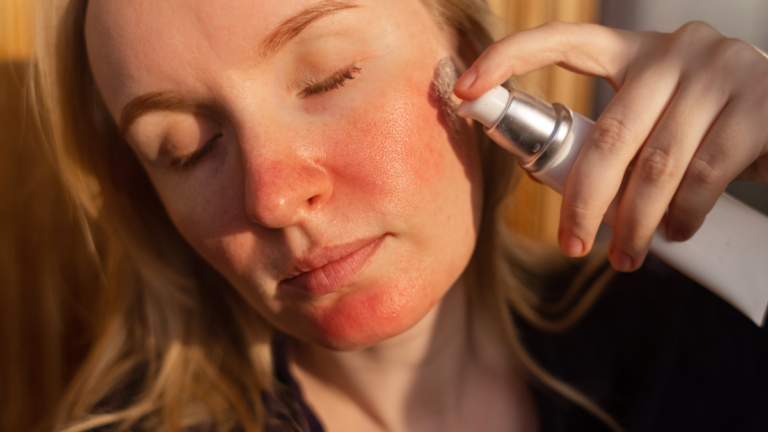

Single creams had each done a little. Metronidazole took the edge off. A retinoid made it worse. Then a dermatologist prescribed a compounded rosacea triple cream, three actives blended into one tube, and for the first time the bumps settled and the red calmed together. Until it plateaued, or the skin got raw, or it was stopped and the rosacea came back. The triple cream is a genuinely good idea. It is also incomplete in two specific, predictable ways.
This guide breaks down what is actually inside a rosacea triple cream, why combining three mechanisms outperforms any single one, and the two blind spots, the yeast and the systemic reservoir, that explain why even a strong triple cream relapses if those are ignored.
A rosacea triple cream is a compounded prescription cream that combines three actives in one base, most commonly metronidazole (anti-inflammatory), azelaic acid (KLK5 and LL-37 inhibitor with some anti-yeast action), and ivermectin (acaricidal against Demodex plus anti-inflammatory). Combining three mechanisms in one step is why it often works better than a single cream. It does not address the vascular redness, the systemic drivers, or robustly the Malassezia yeast, which is why it can still relapse.
|
3-in-1
Distinct mechanisms delivered in a single cream: anti-inflammatory, KLK5-inhibiting, and acaricidal
|
~8x
Higher Demodex density in rosacea skin than in healthy controls, which is why the acaricidal component matters (Chang and Huang meta-analysis)
|
12+ wks
Minimum course to interrupt the Demodex life cycle; stopping earlier is a leading cause of relapse
|
What a rosacea triple cream is
Unlike a single branded tube, a triple cream is usually compounded, mixed to a prescription by a compounding or teledermatology pharmacy. The most widely searched version blends metronidazole, azelaic acid, and ivermectin, though some formulas swap or add agents. Because it is compounded, the exact strengths and the inactive base (often containing propylene glycol and alcohol) vary between pharmacies, and it always requires a prescription.

Why the combination beats a single cream
Rosacea is not driven by one thing, so treating it with one mechanism often leaves gaps. A triple cream covers three at once:
- Ivermectin paralyzes and lowers Demodex mite load, and is independently anti-inflammatory. The mite is the upstream trigger, so reducing it is what gives durable, rather than temporary, improvement. See ivermectin for Demodex.
- Azelaic acid is one of the few topicals shown to directly downregulate KLK5 and reduce LL-37, the enzyme and peptide at the heart of rosacea inflammation, with some activity against Malassezia yeast as well. See azelaic acid for rosacea.
- Metronidazole dampens neutrophil-driven inflammation and reactive oxygen species and has mild activity against the bacteria the mite carries.
These mechanisms are complementary, not redundant, which is why combination topical therapy is endorsed in principle by rosacea consensus guidance. The whole is more than the sum of its parts.
The blind spots: why a strong triple cream can still relapse
If the triple cream is so complete, why do people still relapse on it? Because “three actives” is not “all four drivers,” and because a cream is only one part of a durable plan.

1. The vascular redness it cannot touch
None of the three actives constricts blood vessels. So the persistent background redness and flushing of rosacea often persist even when the bumps have cleared. This is the specific gap filled by a topical vasoconstrictor such as oxymetazoline, or by vascular lasers, layered on top of the cream. Expecting a triple cream to erase redness it was never built to reach is the most common source of disappointment.
2. The systemic reservoir underneath
A subset of patients clears on the cream and relapses each time it is reduced. In most of those cases an unaddressed systemic driver, small intestinal bacterial overgrowth and gut dysbiosis, high alcohol intake, poor sleep, keeps the immune environment in the state that let mites overgrow in the first place. The cream lowers the mites on the skin; it does nothing about the terrain that keeps re-inviting them. This is covered in the Demodex-gut axis guide.
3. Stopped before the life cycle breaks
The Demodex life cycle is roughly 14 to 18 days, and eggs are shielded by a tough shell that topical agents penetrate poorly. Adult mites die under treatment, but a course cut short lets a new generation hatch and reinstall the inflammatory trigger. A minimum of 12 weeks, followed by a maintenance phase, is what actually breaks the cycle, which is a core reason rosacea keeps coming back when any effective agent is stopped too soon.
The yeast question
Because demodex.net/ readers ask this constantly: does a triple cream handle the yeast? Partly. Malassezia yeast overgrowth is a real, separate inflammatory input on rosacea-prone skin, and it dominates in overlap conditions like seborrheic dermatitis and fungal acne. Of the three actives, only azelaic acid has meaningful anti-Malassezia activity, and the combination is not designed around yeast. In a patient whose picture includes greasy central-face scaling or itchy monomorphic bumps along the hairline and chest, the yeast side may need dedicated attention beyond what the triple cream provides. The mite-yeast overlap is explored in the azelaic acid for rosacea guide.
How to use a rosacea triple cream well
- Apply a thin layer once daily, usually in the evening, to the whole affected area after a gentle, fragrance-free cleanse.
- Expect a purge or flare in the first two to four weeks as dying mites release inflammatory content. This is expected, not failure.
- Support the barrier with a ceramide moisturizer and use daily mineral sunscreen; stacking three actives can be drying.
- Commit to a 12-week minimum, then taper to maintenance rather than stopping cold.
- For residual visible redness, add a vascular agent such as oxymetazoline; for a natural acaricidal adjunct consider tea tree oil.
- Use it under clinician supervision; watch for perioral or contact dermatitis from the combined actives and vehicle.
Compounded triple creams lack the quality-control, stability, and pharmacokinetic data of single-agent FDA products, and no fixed-combination RCT exists, so efficacy is extrapolated from monotherapy trials of ivermectin, azelaic acid, and metronidazole plus the combination-therapy principle in rosacea consensus statements. Counsel on the additive irritation risk of stacking azelaic acid, metronidazole, and ivermectin in a propylene-glycol or alcohol base, and on barrier support. The formula addresses the mite and inflammatory nodes but is vascular-silent and does not modify systemic drivers; residual erythema and refractory or relapsing disease still warrant a vascular agent or laser, a systemic-cofactor audit (SIBO, alcohol, sleep), and dermoscopy or standardized skin-surface biopsy to quantify Demodex density before and after treatment.
The takeaway
A rosacea triple cream is one of the stronger topical options available precisely because it refuses to treat rosacea as a one-mechanism disease. It lowers the mite, calms the enzyme, and reduces inflammation in a single step. Understand what it does not reach, the vascular redness, the systemic reservoir, and the full yeast picture, and you can build the rest of the plan around it instead of blaming the cream when the redness lingers. For the complete mechanism and the four-driver framework, see the Demodex and rosacea clinical guide.
Further Reading on demodex.net/
- Demodex and Rosacea: The Complete Clinical Guide
- Ivermectin for Demodex: How It Works and How It Is Used
- Azelaic Acid for Rosacea: The Mite, the Yeast, and the Redness Enzyme
- Oxymetazoline for Rosacea: Why the Redness Comes Back
- Tea Tree Oil for Demodex Mites: A Complete Clinical Guide
- The Demodex-Gut Axis: Why Skin Mites Are a Gut Problem
- Why Demodex Rosacea Keeps Coming Back
Frequently Asked Questions
What is in a rosacea triple cream?
The most common compounded triple cream combines three prescription actives in one base: metronidazole (anti-inflammatory), azelaic acid (KLK5 and LL-37 inhibitor with some anti-yeast action), and ivermectin (acaricidal against Demodex plus anti-inflammatory). Exact percentages and inactive ingredients vary by compounding pharmacy.
Is a triple cream better than Soolantra or metronidazole alone?
For many people, yes, because it hits three mechanisms at once instead of one. Ivermectin lowers mite load, azelaic acid calms the KLK5 and LL-37 pathway, and metronidazole reduces inflammation. The trade-off is more potential for irritation and the fact that no fixed-combo product has its own large trial, so evidence is extrapolated from the single agents.
Does a triple cream cure rosacea?
No topical cures rosacea. A triple cream can produce strong, durable improvement, but rosacea is a chronic condition. It manages the mite and inflammatory drivers on the skin; it does not erase the tendency, and it does not by itself fix the vascular redness or the systemic factors that keep skin mite-permissive.
Why did my triple cream stop working or the redness come back?
Three common reasons. It was stopped before the full 12-week-plus course, so surviving mite eggs hatched and re-ignited inflammation. The persistent background redness is vascular and no ingredient in the cream constricts vessels. Or a systemic driver such as gut dysbiosis, alcohol, or poor sleep is keeping the skin environment favorable to mites.
Can you use a triple cream with oxymetazoline?
Often yes, under clinician supervision, and it is a logical pairing. The triple cream works on the mite and inflammation; oxymetazoline manages the residual visible redness the cream does not address. They act on different parts of the problem.
Does a triple cream address Demodex and yeast?
It directly addresses Demodex through its ivermectin component. Yeast is only partly covered: azelaic acid has some activity against Malassezia, but the combination is not designed around yeast, so in patients with a strong seborrheic or fungal-acne overlap the yeast side may need separate attention.
References and Evidence Sources
- Stein Gold L, Kircik L, Fowler J, et al. Long-term safety of ivermectin 1% cream versus azelaic acid 15% gel in treating inflammatory lesions of rosacea: results of two 40-week trials. J Drugs Dermatol. 2014;13(11):1380-1386.
- Paichitrojjana A. Efficacy of topical ivermectin in Demodex-associated rosacea: a systematic review and meta-analysis. Clin Cosmet Investig Dermatol. 2025. PMC12523798.
- Elewski BE, Fleischer AB, Pariser DM. A comparison of 15% azelaic acid gel and 0.75% metronidazole gel in the topical treatment of papulopustular rosacea. Arch Dermatol. 2003;139(11):1444-1450.
- Coda AB, Hata T, Miller J, et al. Cathelicidin, kallikrein 5, and serine protease activity is inhibited during treatment of rosacea with azelaic acid 15% gel. J Am Acad Dermatol. 2013;69(4):570-577.
- Schaller M, Almeida LMC, Bewley A, et al. Rosacea treatment update: recommendations from the global ROSacea COnsensus (ROSCO) panel. Br J Dermatol. 2017;176(2):465-471.
- Schaller M, Almeida LMC, Bewley A, et al. Recommendations for rosacea diagnosis, classification and management: update from the global ROSacea COnsensus 2019 panel. Br J Dermatol. 2020;182(5):1269-1276.
- Chang YS, Huang YC. Role of Demodex mite infestation in rosacea: a systematic review and meta-analysis. J Am Acad Dermatol. 2017;77(3):441-447. PMID 28711190.
- Kurniadi I, Widjaja NA, et al. Malassezia virulence factors and their role in dermatological disorders. Acta Dermatovenerol Alp Pannonica Adriat. 2022.
- Parodi A, Paolino S, Greco A, et al. Small intestinal bacterial overgrowth in rosacea: clinical effectiveness of its eradication. Clin Gastroenterol Hepatol. 2008;6(7):759-764.
- Rather PA, Hassan I. Human Demodex mite: the versatile mite of dermatological importance. Indian J Dermatol. 2014;59(1):60-66.
Find your likely mite density and get a personalized protocol in about 2 minutes.
About the Author
Marina Ivakhnenko is a clinical writer and editorial lead at demodex.net/, where she develops evidence-based content for patients and practitioners managing Demodex mite overgrowth. Her work draws on peer-reviewed dermatology, ophthalmology, and parasitology literature and is reviewed by the demodex.net/ clinical advisory board.
Medical Disclaimer: This article is intended for educational use and does not constitute medical advice. Diagnosis and treatment of rosacea or any Demodex-related condition should be carried out under the supervision of a qualified dermatologist or other licensed healthcare provider. See the full disclaimer at demodex.net/medical-disclaimer.


