
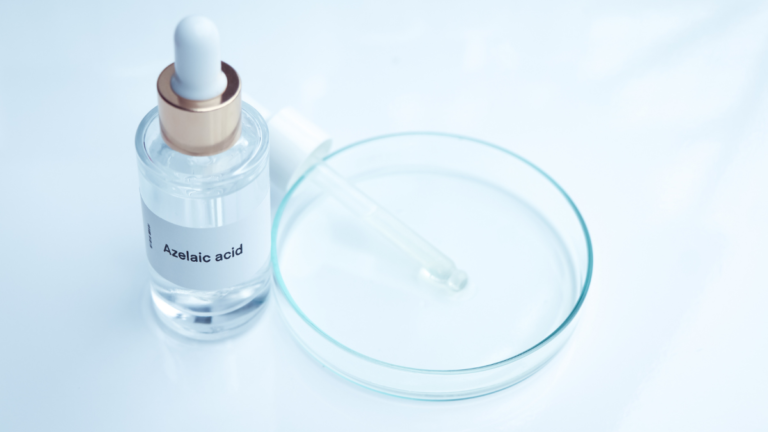

You searched azelaic acid for rosacea because something calmer than a harsh acid and gentler than an antibiotic sounded right. It usually is. But most articles describe azelaic acid as a simple anti-redness cream and stop there. That undersells it, and it also explains why some people are disappointed: they use it as their only treatment, the papules fade a little, and then the skin drifts back.
Here is the part that changes how you use it. On a Demodex-driven face, rosacea is not one problem. It is a mite, the bacteria the mite carries, a yeast sharing the same oily follicles, and an inflammatory enzyme that all feed each other. Azelaic acid is unusual because it touches three of those four at once. Understanding which three is the difference between a cream that helps and a routine that holds.
Quick answer
Azelaic acid for rosacea works on the inflammation, the Demodex-associated bacterium Bacillus oleronius, and the Malassezia yeast that drives flaky, frosted texture. It directly lowers the KLK5 and LL-37 pathway that produces redness. It does not kill the mite itself, so its best role is alongside a mite-targeted agent such as topical ivermectin or a standardized tea tree oil preparation. Prescription strength is 15 percent gel or foam, twice daily, for at least twelve weeks.
Why Rosacea Keeps Coming Back on a Mite-Driven Face
When Demodex density climbs above roughly five mites per square centimetre, the pilosebaceous unit gets loud. The mites carry surface antigens and a bacterium called Bacillus oleronius that switch on toll-like receptor 2 (TLR2) on skin cells. TLR2 activation drives up a protein-cutting enzyme, kallikrein-5 (KLK5). KLK5 converts an inactive precursor into LL-37 cathelicidin, the peptide that acts as the master switch for rosacea redness, swelling, and new blood vessel growth.
This is why anti-redness monotherapy relapses. Most rosacea creams quiet the downstream inflammation but leave the upstream trigger, the mite and its cargo, untouched. Stop the cream and the trigger fires again on a predictable timetable. If that pattern sounds familiar, our guide on why rosacea keeps coming back walks through the cycle in detail.

The Three Things Azelaic Acid Actually Does
1. It lowers KLK5 and cathelicidin, the redness enzymes
This is azelaic acid’s best-documented action in rosacea. In laboratory and patient studies, 15 percent azelaic acid gel directly reduced KLK5, TLR2, and cathelicidin expression, and patients with the highest baseline serine protease activity showed the biggest drop after treatment. In plain terms, it turns down the exact enzyme that translates mite activity into visible flushing and papules. Few topical agents do this so directly, which is why azelaic acid is often called the most evidence-based KLK5 inhibitor available over the counter and by prescription.
2. It suppresses Bacillus oleronius, the mite’s bacterial cargo
The mite does much of its damage through the microbes it carries. Bacillus oleronius released from dying mites provokes a strong immune response in most people with papulopustular rosacea. In controlled laboratory testing, azelaic acid impeded the growth of B. oleronius along with Staphylococcus species and Cutibacterium acnes. By reducing the bacterial signal, azelaic acid takes pressure off the TLR2 to KLK5 loop from the microbial side, not just the enzyme side.
3. It suppresses Malassezia, the yeast hiding in your rosacea
Here is the part almost no rosacea article mentions. Azelaic acid is a natural metabolite of Malassezia furfur, the yeast that lives in oily human follicles. The dermatological grade used in products is actually produced from this yeast. And in the same laboratory testing, azelaic acid inhibited Malassezia furfur as well. That matters because Malassezia and Demodex share the same sebum-rich territory on the central face, and Malassezia is a major cause of the dry, frosted, flaky texture people mistake for simple sensitivity. A cream that calms redness but ignores the yeast leaves that texture behind. Azelaic acid addresses both. Our guide on the Demodex and yeast overlap explains why the two so often travel together.

What Azelaic Acid Does Not Do
Honesty is what makes a routine work. Azelaic acid is not a true acaricide. It does not paralyze or kill Demodex on contact the way ivermectin or terpinen-4-ol (the active in tea tree oil) does. So if elevated mite density is the engine of your rosacea, azelaic acid alone will improve the inflammation and texture but may not lower the mite count enough to prevent relapse. This is not a weakness to hide. It is the reason azelaic acid is almost always used as a partner rather than a solo act.

How to Use Azelaic Acid for Rosacea
The routine below reflects how dermatologists commonly sequence azelaic acid within a mite-aware plan. Introduce one change at a time and keep the barrier calm.
Strength and form. Prescription 15 percent gel or foam has the strongest rosacea evidence. Over-the-counter serums (usually 10 percent or less) are gentler for maintenance or very sensitive skin.
Frequency. Start every other night for the first week to let the skin adapt, then move to twice daily as tolerated. A brief tingle is normal and usually fades within two weeks.
Pairing. A common dual-mechanism pattern is azelaic acid in the morning and a mite-targeted agent such as topical ivermectin (or standardized tea tree oil) at night, under dermatologist supervision. Azelaic acid handles the inflammation, bacteria, and yeast; the acaricide lowers the mite load.
Barrier support. Always follow with a fragrance-free ceramide moisturizer and use a mineral sunscreen each morning. A settled barrier is what makes the active phase tolerable.
Duration. Commit to at least twelve weeks. The Demodex life cycle is about two weeks, and shorter courses tend to relapse as new mite cohorts hatch. For the full staged plan, see the Demodex and rosacea clinical guide.
For practitioners
Azelaic acid occupies a specific mechanistic niche: it is a KLK5 and cathelicidin down-regulator with in vitro activity against B. oleronius and Malassezia furfur, but it is not acaricidal. Position it as the anti-inflammatory and anti-microbial arm of a dual-mechanism regimen rather than a stand-alone.
Head-to-head data (Elewski 2003) show 15% azelaic acid gel matching or exceeding 0.75% metronidazole gel for papulopustular lesion reduction. Mechanistic work (Coda/Gallo) confirms reductions in KLK5, TLR2, and cathelicidin mRNA. For patients whose texture includes a seborrheic or frosted quality, the Malassezia-suppressive property is a practical advantage over metronidazole.
Reasonable pairing: azelaic acid AM plus topical ivermectin PM, layered on a ceramide base, for a minimum of twelve weeks, with taper to maintenance. Consider density confirmation before committing patients to prolonged acaricidal therapy.
Not sure how many mites you are dealing with?
Estimate your Demodex density and get a personalized starting protocol in 2 minutes.
Frequently Asked Questions
Does azelaic acid kill Demodex mites?
Not directly. Unlike ivermectin or tea tree oil, azelaic acid is not a true acaricide, so it does not paralyze or kill the mite on contact at the concentrations used on skin. What it does is remove much of what makes the mite harmful. It suppresses Bacillus oleronius (the bacterium the mite carries) and the Malassezia yeast that shares the same follicles, and it directly lowers the KLK5 and LL-37 signal that turns mite activity into visible redness. That is why azelaic acid works best paired with a mite-targeted agent, not on its own.
What strength of azelaic acid is best for rosacea?
The prescription strengths studied in rosacea are 15 percent gel and 15 percent foam, applied twice daily. Over-the-counter serums are usually 10 percent or lower and are gentler but less studied for inflammatory rosacea. For papules and pustules, the 15 percent prescription forms have the strongest evidence. A 20 percent cream exists but is formulated for acne and pigmentation rather than rosacea.
How long until azelaic acid works for rosacea?
Expect mild stinging and a settling-in period in the first two weeks. Meaningful reduction in papules and redness usually appears between weeks 4 and 8, with fuller benefit by week 12. Because the Demodex life cycle runs about two weeks, courses shorter than twelve weeks tend to relapse. Consistency matters more than strength.
Can I use azelaic acid with ivermectin or tea tree oil?
Yes, and this is where it shines. A common dermatologist-supervised pattern is azelaic acid in the morning and a mite-targeted agent such as topical ivermectin (or a standardized tea tree oil preparation) in the evening. Azelaic acid calms the inflammation and the microbial cargo while the acaricide lowers the mite count. Read the ivermectin guide and the tea tree oil guide before combining.
Is azelaic acid safe for sensitive or rosacea-prone skin?
It is generally well tolerated and can be used for years. The main early complaint is a transient tingling or burning that fades. Pair it with a fragrance-free ceramide moisturizer, introduce it every other night at first, and always use sunscreen. Because it is not photosensitizing and is considered low-risk in pregnancy, it is often chosen when other rosacea drugs are not suitable.
Does azelaic acid help the flaky, frosted texture on my skin?
Often, yes. That dry, frosted, matte look over the pores is frequently a sign of Malassezia yeast activity layered on top of rosacea. Because azelaic acid suppresses Malassezia and gently normalizes the follicle lining, it can improve that texture where a pure anti-redness cream would not. See our guide on Demodex and yeast overlap.
Further Reading on demodex.net/
- Demodex and Rosacea: The Complete Clinical Guide
- Red Light Therapy for Rosacea: What the Evidence Really Shows
- Ivermectin for Demodex: How It Works
- Tea Tree Oil for Demodex: A Complete Clinical Evidence Guide
- Demodex and Yeast: The Malassezia Overlap
- Natural Remedies for Demodex: A Clinical Evidence Review
- Demodex Research Library
- Find a Demodex-Aware Practitioner
References
- Mariano-Rodriguez V, et al. Azelaic Acid in Dermatology: A Review of Its Mechanism of Action. Cureus. 2025;17(10):e94491.
- Coda AB, Hata T, Miller J, et al. Cathelicidin, kallikrein 5, and serine protease activity is inhibited during treatment of rosacea with azelaic acid 15% gel. J Am Acad Dermatol. 2013;69(4):570-577.
- Kurniadi I, Lim HW, Widaty S, et al. Malassezia virulence factors and their role in dermatological disorders. Acta Dermatovenerol Alp Pannonica Adriat. 2022.
- Reinholz M, et al. Evidence for the Clinical Association between Demodex and Rosacea: A Review. Dermatology. 2024;240(1):95-105.
- Yang F, Wang L, Song D, et al. Signalling pathways and targeted therapy in rosacea (mechanistic review). Front Immunol. 2024;15:1367994.
- Searle T, Ali FR, et al. The multiple uses of azelaic acid in dermatology: mechanism of action, preparations, and potential therapeutic applications. Postepy Dermatol Alergol. 2022.
- Elewski BE, Fleischer AB Jr, Pariser DM. A comparison of 15% azelaic acid gel and 0.75% metronidazole gel in the topical treatment of papulopustular rosacea: results of a randomized trial. Arch Dermatol. 2003;139(11):1444-1450.
- Chang YS, Huang YC. Role of Demodex mite infestation in rosacea: a systematic review and meta-analysis. J Am Acad Dermatol. 2017;77(3):441-447.e6.
About the Author
Marina Ivakhnenko is a clinical writer and editorial lead at demodex.net/, where she develops evidence-based content for patients and practitioners managing Demodex mite overgrowth. Her work draws on peer-reviewed dermatology, ophthalmology, and parasitology literature and is reviewed by the demodex.net/ clinical advisory board.
Medical Disclaimer: This article is for educational use and does not constitute medical advice. Diagnosis and treatment of rosacea or any Demodex-related condition should be carried out under the supervision of a qualified dermatologist or other licensed healthcare provider. See the full disclaimer at demodex.net/medical-disclaimer.


