
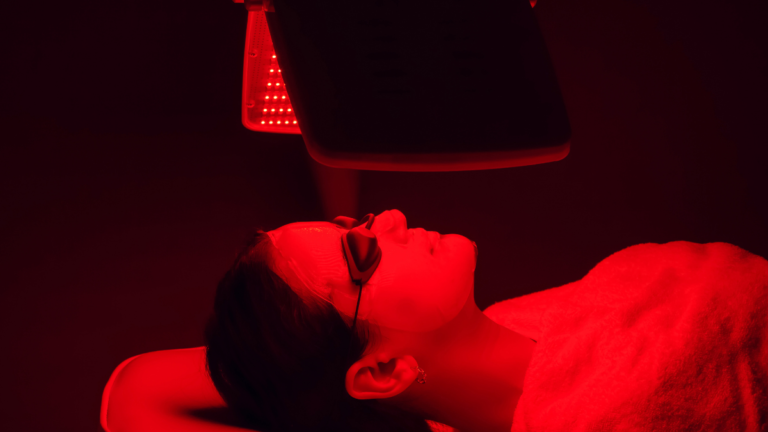

You searched red light therapy for rosacea hoping for something gentle that finally works, and the marketing around LED masks is loud and confident. Some of it is earned. Some of it is not. The honest version is more useful than the hype, and it is the version that will actually help your skin.
The core question this guide answers is the one the ads skip: does the light reach the thing driving your rosacea? On a Demodex-influenced face there are three drivers, redness, yeast, and the mite, and different colors of light reach different ones. Red light is genuinely good at one of them and close to useless at another. Knowing which is which is the whole point.
Quick answer
Red light therapy for rosacea is a real anti-inflammatory tool. Red wavelengths (630 to 660 nm) calm the redness and support the skin barrier, and the evidence for that is solid. But red light does not meaningfully kill Demodex mites, and it does little to Malassezia yeast. Blue light (around 415 nm) is what targets the yeast and excess oil; intense pulsed light (IPL) is the modality with real evidence for reducing Demodex. Use red light for calm, add blue for yeast, and reach for IPL or an acaricide for the mite.
How Red Light Actually Works on Skin
Red and near-infrared light drive a process called photobiomodulation. Photons are absorbed by an enzyme in the mitochondria (cytochrome c oxidase), which nudges cells toward more energy production and a calmer, less inflammatory state. In rosacea terms, that means lower pro-inflammatory signaling, a quieter inflammatory infiltrate, and support for the small vessels and collagen in the upper dermis. Large reviews of red LED therapy in dermatology report the strongest evidence for acne and inflammatory conditions, with visible redness reduction being a consistent theme.
The key word is depth. Red light reaches the mid-dermis where the redness and vessels live. That is exactly why it helps flushing. It is also why it struggles with targets that sit elsewhere, or that are shielded inside the follicle.

Where Red Light Falls Short: the Mite and the Yeast
Red light and Demodex mites
This is where the marketing gets ahead of the science. There is no good evidence that red light alone kills Demodex at the doses delivered by home devices. The mite lives protected inside the pilosebaceous follicle, and red light is an inflammation modulator, not an acaricide. The light-based treatment that does reduce mite counts is intense pulsed light, which is broad-spectrum and works partly by heat. In a 2025 systematic review and meta-analysis of ocular demodicosis, IPL significantly raised the rate of Demodex eradication (risk ratio 1.41), and a 2024 study found that combining IPL with topical ivermectin resolved Demodex blepharitis and improved gland function. A randomized trial even found IPL performing comparably to tea tree oil for mite reduction. That is a different tool from an LED mask.
Red light and Malassezia yeast
If your rosacea comes with a dry, frosted, flaky texture, a yeast called Malassezia is often part of the story. And here red light does very little. When researchers tested LED across many wavelengths against Malassezia species, only very narrow bands near the ultraviolet edge (around 380 to 392 nm) suppressed the yeast, while red light at 630 nm had no antifungal effect at all. The color that does the work is blue light near 415 nm, which is absorbed by porphyrins the yeast produces and generates a targeted antifungal effect. Blue light also reduces sebocyte activity, trimming the oil supply that feeds both yeast and mites. Formal photodynamic therapy has even been used for stubborn Malassezia folliculitis. This is why a red-only mask can calm your redness yet leave the frosted texture behind, and why our guide on the yeast overlap matters here.


How to Use Light Therapy for Rosacea Sensibly
Match the light to the target, and let it support a mite-aware routine rather than replace it.
For redness and barrier calm. A home red light device, about 10 minutes, three to five times weekly, over 8 to 12 weeks. Protect the eyes and start short if skin is irritated.
For frosted, yeast-driven texture. Choose a device that includes blue light (many masks are red plus blue), or discuss blue-light or photodynamic options with a clinician. Red alone will not clear the yeast.
For visible vessels and mite reduction. In-office IPL has the strongest evidence, particularly for vascular redness and for Demodex around the eyelids. It is a clinic treatment, not a home gadget.
For the mite itself. Light is an adjunct. A true acaricide such as topical ivermectin or a standardized tea tree oil preparation does the mite-lowering work. See the ivermectin guide and the tea tree oil guide, and combine under guidance using the rosacea clinical guide.
For practitioners
Set expectations by wavelength. Red and NIR photobiomodulation is a credible anti-inflammatory and barrier adjunct, but it is not acaricidal and shows negligible direct activity against Malassezia (only near-UV bands ~380 to 392 nm suppress the yeast in vitro). Blue light (~415 nm) provides porphyrin-mediated antifungal activity and sebosuppression; combination red-plus-blue devices are therefore more rational for rosacea overlapping with a seborrheic or Malassezia-driven phenotype.
For actual Demodex reduction, the evidence base is IPL, not LED. A 2025 meta-analysis of ocular demodicosis reported a significant eradication risk ratio (1.41), strongest with adjunctive meibomian gland expression; a 2024 series combined IPL with ivermectin 1% for Demodex blepharitis with meibomian gland improvement. Position IPL as vascular-plus-acaricidal, LED as anti-inflammatory maintenance.
Practical framing for patients: light supports the plan, it does not carry it. Pair with a confirmed acaricidal regimen and assess for ocular involvement, where IPL has its clearest role.
Not sure how many mites you are dealing with?
Estimate your Demodex density and get a personalized starting protocol in 2 minutes.
Frequently Asked Questions
Does red light therapy kill Demodex mites?
On its own, red light does not meaningfully kill Demodex. Red wavelengths (around 630 to 660 nm) are anti-inflammatory and work on the redness and barrier side of rosacea, but they do not reach or destroy the mite in the follicle the way an acaricide does. The light modality with real mite-reduction evidence is intense pulsed light (IPL), which is broad-spectrum and photothermal. In a 2025 meta-analysis, IPL significantly increased the rate of Demodex eradication, especially when combined with meibomian gland expression or topical ivermectin.
Does red light therapy help rosacea redness?
Yes, this is its genuine strength. Photobiomodulation with red light reduces pro-inflammatory signaling, calms the inflammatory infiltrate, and supports the dermal matrix and small vessels. Reviews report visible reductions in facial redness and improved skin texture with consistent use. Think of red light as a redness and barrier tool, not a mite treatment.
Red light or blue light for rosacea with yeast?
If flaky, frosted, seborrheic texture is part of your picture, blue light matters. Blue light around 415 nm is absorbed by porphyrins in Malassezia yeast, producing an antifungal effect, and it also reduces sebocyte activity, lowering the oil that feeds both yeast and mites. Red light does little to Malassezia directly. Many consumer LED masks combine red and blue, which is why the combination often outperforms red alone for rosacea layered with yeast. See our guide on the Demodex and yeast overlap.
Is IPL better than an LED mask for rosacea?
They do different jobs. An at-home LED mask (red, or red plus blue) is a gentle, ongoing anti-inflammatory and, with blue, anti-yeast tool. In-office IPL is a stronger, photothermal treatment that targets visible vessels and has the best evidence for actually lowering Demodex counts, particularly around the eyelids in Demodex blepharitis. For vascular redness and mite reduction, IPL leads. For daily maintenance and barrier calm, an LED mask fits. Many people use both.
How often should I use red light therapy for rosacea?
Home red light devices are typically used for about 10 minutes, three to five times per week, with benefit building over 8 to 12 weeks. Consistency matters more than long single sessions. Always protect the eyes and start with shorter sessions if your skin is actively irritated. Red light is well tolerated and, unlike UV phototherapy, does not carry a burn or photosensitivity risk.
Can I use red light therapy with my rosacea creams?
Usually yes, and it can be complementary. Red light pairs well with a mite-targeted routine because it handles the inflammation while the acaricide handles the mite. Avoid using light immediately after a photosensitizing topical unless a clinician has planned it (for example, in formal photodynamic therapy). Space light sessions and actives, and keep the barrier supported with a ceramide moisturizer.
Further Reading on demodex.net/
- Demodex and Rosacea: The Complete Clinical Guide
- Azelaic Acid for Rosacea: The Mite, Yeast and Redness Enzyme
- Ivermectin for Demodex: How It Works
- Tea Tree Oil for Demodex: A Complete Clinical Evidence Guide
- Demodex and Yeast: The Malassezia Overlap
- Demodex Blepharitis: When the Eyelids Are Involved
- Demodex Research Library
- Find a Demodex-Aware Practitioner
References
- Maghfour J, Ozog DM, Mineroff J, Jagdeo J, Kohli I, Lim HW. Photobiomodulation CME part I: overview and mechanism of action. J Am Acad Dermatol. 2024;91(5):793-802.
- Mineroff J, Maghfour J, Ozog DM, Lim HW, Kohli I, Jagdeo J. Photobiomodulation CME part II: clinical applications in dermatology. J Am Acad Dermatol. 2024;91(5):805-815.
- Photobiomodulation for the treatment of rosacea: a review. Lasers Med Sci. 2025.
- Photobiomodulation and Photodynamic Therapy Using Red LED Light in Dermatology: A Narrative Review (59 studies, 1,882 patients). Bratisl Med J. 2025.
- Safir M, Rabina G, Arbel I, et al. Ivermectin 1% combined with intense pulsed light treatment for dry eye disease secondary to Demodex blepharitis. Cornea. 2024 (doi:10.1097/ICO.0000000000003774).
- Therapeutic effect of intense pulsed light in ocular demodicosis: a systematic review and meta-analysis (Demodex eradication risk ratio 1.41, 95% CI 1.18-1.69). Cont Lens Anterior Eye. 2025.
- The photothermal effect of intense pulsed light and LipiFlow in eyelid-related ocular surface diseases: meibomian gland dysfunction, Demodex and blepharitis. 2024.
- Wikramanayake TC, et al. The antifungal effect of light-emitting diode on Malassezia yeasts. J Photochem Photobiol B. 2012.
- Kim SK, et al. Photodynamic therapy: new treatment for recalcitrant Malassezia folliculitis. J Dermatolog Treat / PubMed PMID 20166153.
- Light-emitting diode light therapy for facial seborrhoeic dermatitis: a case report. PMC8423200.
About the Author
Marina Ivakhnenko is a clinical writer and editorial lead at demodex.net/, where she develops evidence-based content for patients and practitioners managing Demodex mite overgrowth. Her work draws on peer-reviewed dermatology, ophthalmology, and parasitology literature and is reviewed by the demodex.net/ clinical advisory board.
Medical Disclaimer: This article is for educational use and does not constitute medical advice. Diagnosis and treatment of rosacea or any Demodex-related condition should be carried out under the supervision of a qualified dermatologist or other licensed healthcare provider. See the full disclaimer at demodex.net/medical-disclaimer.


