

She has been to three dermatologists. The first called it adult acne and prescribed doxycycline. The second called it rosacea and prescribed metronidazole. The third called it perioral dermatitis and told her to stop using steroid cream. Each treatment worked for about six weeks. Each time it wore off, the papules came back across the cheeks and chin, the skin stayed rough and dry no matter how much moisturiser she used, and her hair kept thinning. Nobody had checked her thyroid. Nobody had counted her mites.
This is the clinical picture that sits at the intersection of Demodex and thyroid disease, and it is one of the most consistently missed patterns in dermatology. Two conditions are running in the same patient, each one making the other harder to treat, and each one being managed by a different specialist who cannot see the other half of the problem.
Quick answer
Yes, there is a real and now measurable link between Demodex and thyroid disease. Two independent studies have found that patients with autoimmune thyroid disease carry significantly higher Demodex mite densities than healthy controls. A 2025 cohort of 201 patients published in Parasite Immunology went further and showed that the higher a patient’s anti-TPO antibody level, the higher their Demodex count, and that mite count itself had predictive value for anti-TPO positivity. The relationship appears to run through two doors: hypothyroid skin becomes dry, rough, and slow to turn over, which changes the follicular environment, and autoimmune activity loosens the local immune control that normally keeps mite numbers down.
What Does the Thyroid Have To Do With Skin Mites?
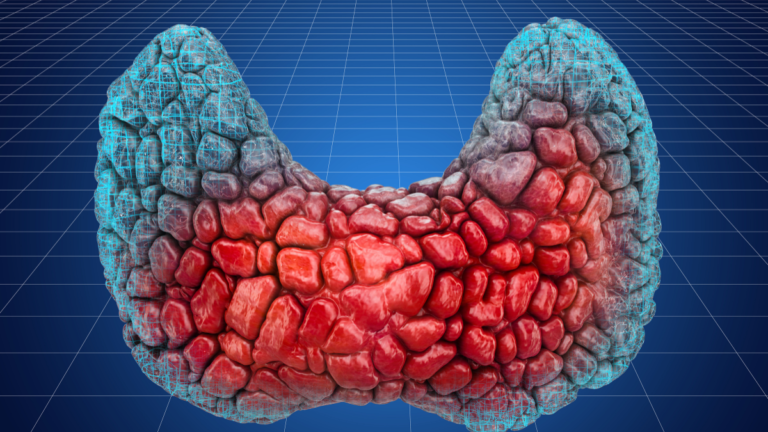
More than most people expect. The thyroid is not a distant organ that only controls metabolism and energy. Thyroid hormone receptors sit directly in skin tissue, including in keratinocytes, fibroblasts, and the sebaceous gland. When thyroid signalling changes, the skin changes with it.
In hypothyroidism, and in the autoimmune thyroiditis that most commonly causes it, three things happen to the skin that are directly relevant to Demodex:
- Epidermal turnover slows. Dead cells linger. Follicular openings become plugged rather than clear.
- The skin becomes xerotic. Dryness, roughness, and scaling are among the most common cutaneous signs of hypothyroidism.
- Cutaneous immune surveillance shifts. Autoimmune disease is, by definition, a disorder of immune regulation. That dysregulation does not stop at the thyroid gland.
Each of those changes makes the follicle a more hospitable place for a mite that lives inside it.

The 2025 Study That Changed the Picture
Until recently the connection between Demodex and thyroid disease was a clinical suspicion supported by a single study. That changed in July 2025, when a research team at Kayseri City Education and Research Hospital published a cohort study in Parasite Immunology that measured both variables in the same patients.
They recruited 201 patients with demodicosis or rosacea. For each patient they measured thyroid hormones (TSH, T3, T4), anti-thyroid peroxidase (anti-TPO) antibodies, and Demodex count using standardised superficial skin biopsy. They then classified the skin presentation as Type 1 (erythema, telangiectasia, rough skin) or Type 2 (papules and pustules).
Three findings stand out.
1. Higher thyroid antibodies, higher mite counts
Patients with elevated anti-TPO levels had significantly higher Demodex counts (p < 0.05). The correlation between mite count and anti-TPO was positive and statistically significant.
2. The papulopustular subtype carried the link
Both Demodex positivity and elevated anti-TPO were strongly associated with Type 2 demodicosis, the papules-and-pustules presentation (p < 0.001 and p = 0.008 respectively). This is the presentation most often misdiagnosed as adult acne.
3. The mite count predicted the antibody
This is the finding with the most practical weight. Demodex count had predictive value for anti-TPO positivity (p = 0.004). In plain terms: a high mite count on a skin biopsy was a signal worth following up with a thyroid antibody test.
The Earlier Study: Hashimoto’s Patients Have More Mites
The 2025 work built on a 2022 study published in the Journal of Cosmetic Dermatology, which approached the question from the opposite direction. Instead of starting with skin patients and testing their thyroids, it started with 78 confirmed Hashimoto’s thyroiditis patients from an endocrinology clinic and compared them with 41 controls who had no thyroid or skin disease.
Hashimoto’s patients were significantly more likely to have increased Demodex density (p < 0.001). Mite density correlated with two specific clinical signs: xerosis (p = 0.010) and spiny follicular papules (p = 0.008).
That second sign is worth pausing on. Spiny follicular papules are small, rough, gritty bumps centred on the follicle. Patients describe the texture as sandpaper. It is the same texture finding that shows up repeatedly in Demodex on the face and in the Demodex-rosacea literature, and it is one of the more reliable bedside clues that mites are involved.

Where the Symptoms Show Up
Because thyroid disease affects skin everywhere, and because Demodex concentrates where sebaceous glands are densest, the overlap presents in predictable places.
On the face
Papules and pustules across the cheeks, chin, and nasolabial folds, with rough or sandpaper texture between the lesions. Often diagnosed as adult acne or rosacea. See Demodex on the face.
On the scalp
Itching, flaking, and follicular bumps. Hypothyroidism independently causes hair shedding by shortening the growth phase of the hair cycle, so scalp Demodex and thyroid-driven shedding frequently arrive together and get blamed on each other. See Does Demodex cause hair loss? and Demodex mites on the scalp.
On the eyelids
Grittiness, crusting at the lash base, and the cylindrical collarettes that define Demodex blepharitis. Thyroid eye disease is a separate entity, but ocular surface symptoms in a thyroid patient deserve a lash-margin examination rather than an assumption.
On the eyebrows
Thinning of the outer third of the eyebrow is a classic hypothyroid sign. Demodex also colonises brow follicles. A patient losing brow hair should have both explanations on the table.
Which Comes First?
Neither study proves causation, and this needs saying plainly rather than being glossed over. What the data show is association, in two directions:
- Thyroid autoimmunity may create skin conditions that favour Demodex proliferation (dry, slow-turnover skin with altered immune surveillance).
- Elevated Demodex density may be a marker that points towards undiagnosed thyroid autoimmunity, which is why the 2025 authors proposed combining mite counts with thyroid antibody testing.
It is also entirely possible that both are downstream of a third factor, since immune dysregulation is a common denominator in Demodex and immunosuppression and in Demodex and diabetes as well. The honest position is that the association is now well documented, the mechanism is plausible, and the direction of causality is not settled.
For practitioners
Two practical implications follow from the 2025 data.
1. Thyroid antibodies in treatment-resistant papulopustular disease. In a patient with Type 2 demodicosis or papulopustular rosacea that has failed multiple courses of standard therapy, anti-TPO is a cheap test with a reasonable pre-test probability. The 2025 cohort found mite count itself had predictive value for anti-TPO positivity (p = 0.004).
2. Skin assessment in the Hashimoto’s patient. The 2022 cohort found elevated Demodex density in Hashimoto’s patients drawn from an endocrinology clinic, not a dermatology clinic. These were patients who had not presented with a skin complaint. Xerosis and spiny follicular papules in a thyroid patient are worth a standardised skin surface biopsy rather than an emollient prescription.
Caveats. Both studies are Turkish single-centre cohorts with modest sample sizes. Neither is a randomised trial and neither establishes causation. The correlation coefficient in the 2025 study was weak (r = 0.144) even though it reached significance. Treat this as a signal worth acting on clinically, not as settled pathophysiology.
What To Do If This Sounds Like You
The two problems need to be worked up in parallel, not sequentially, because each one slows the resolution of the other.
Confirm the mite side
A standardised skin surface biopsy or dermoscopy quantifies Demodex density against the clinical threshold of roughly five mites per square centimetre. Guessing from appearance alone is unreliable, because Demodex, bacterial acne, and fungal folliculitis look similar. See How to test for Demodex mites.
Confirm the thyroid side
Ask for the full panel, not TSH alone: TSH, free T3, free T4, and anti-TPO plus anti-thyroglobulin antibodies. TSH can sit within the reference range while conversion of T4 to T3 is impaired, and antibodies can be elevated before TSH ever moves.
Address both
Reducing mite density with an evidence-based acaricidal protocol will not correct thyroid autoimmunity, and correcting thyroid function will not by itself clear an established mite overgrowth. Patients who improve durably tend to be the ones whose clinicians worked both sides. The relevant protocols are set out in the complete Demodex treatment protocol, the tea tree oil clinical guide, and the natural remedies evidence review.
Important
Never start, stop, or adjust thyroid medication on your own, and do not delay endocrine care while pursuing a skin protocol. Autoimmune thyroid disease is a medical condition requiring physician management. Nothing in this article is a substitute for that care.
Further Reading on demodex.net/
- Demodex and Diabetes: The Blood Sugar Connection
- Demodex and Immunosuppression: Steroids, Biologics, and Why the Cream Made It Worse
- Demodex and Hormonal Acne: Why Adult Acne Will Not Clear
- Demodex and Rosacea: The Complete Clinical Guide
- The Demodex-Gut Axis
- Demodex Research Library
- Find a Demodex-Aware Practitioner
Frequently Asked Questions
Can thyroid problems cause Demodex?
Thyroid problems do not cause Demodex mites to appear, because almost every adult already carries them. What the evidence suggests is that autoimmune thyroid disease creates conditions in which existing mites can multiply beyond the density at which they cause disease. Two cohorts have now found significantly higher Demodex density in thyroid patients compared with controls.
Is there a link between Hashimoto’s and rosacea?
Yes, and the Demodex connection may be part of why. Rosacea has been associated with thyroid autoimmunity in case-control research, and the 2025 Parasite Immunology cohort recruited patients with demodicosis or rosacea and found anti-TPO levels tracked with mite counts. A patient with rosacea that resists standard therapy is reasonable to screen for thyroid antibodies.
Should I get my thyroid tested if I have Demodex?
If your Demodex-related skin disease is papulopustular and has failed multiple standard treatments, it is a reasonable conversation to have with your doctor. The 2025 study found mite count had predictive value for anti-TPO positivity. Ask for TSH, free T3, free T4, and thyroid antibodies rather than TSH alone.
Does treating my thyroid clear my skin?
Not on its own, in most cases. Correcting thyroid function addresses the environment that allowed mite overgrowth, but an established Demodex population does not disappear when TSH normalises. Most patients need the mite density addressed directly as well. Equally, an acaricidal protocol alone tends to relapse if the thyroid driver is left uncorrected.
Why is my skin so dry and rough with Hashimoto’s?
Low thyroid hormone slows epidermal turnover and reduces the skin’s ability to hold water, producing the xerosis and rough texture that are classic hypothyroid signs. The 2022 study found that this same xerosis correlated significantly with Demodex density (p = 0.010), which suggests the dryness and the mites are not two separate problems in these patients.
What are spiny follicular papules?
They are small, rough, gritty bumps centred on the hair follicle, often described by patients as a sandpaper texture. In the 2022 Hashimoto’s cohort they correlated significantly with Demodex density (p = 0.008). They are one of the more useful bedside clues that mites are involved rather than ordinary dryness.
Can Demodex cause hair loss if I have thyroid disease?
Both can cause shedding, through different mechanisms, and they frequently occur together. Hypothyroidism shortens the hair growth phase. Demodex causes follicular inflammation. A patient with both needs both addressed, and should not assume that all of the shedding belongs to one cause. See our guide on Demodex and hair loss.
References
- Yucel MB, Unal E, Ertas R. Demodicosis and Thyroid Autoimmunity: Unravelling the Connection. Parasite Immunology. 2025;47(7):e70016. doi:10.1111/pim.70016. PubMed 40659514
- Topcu Dursun R, et al. Could there be an association between Hashimoto’s thyroiditis and demodex infestation? Journal of Cosmetic Dermatology. 2022. doi:10.1111/jocd.15005. PubMed 35486704
- Rosacea is associated with thyroid autoimmunity: a case control study. PMC6516508
- Keles H, Pancar Yuksel E, Aydin F, Senturk N. Pre-Treatment and Post-Treatment Demodex Densities in Patients under Immunosuppressive Treatments. Medicina (Kaunas). 2020;56(3):107. PMC7142658
- Akcinar UG, Unal E, Dogruman Al F. Demodex spp. as a possible aetiopathogenic factor of acne and relation with acne severity and type. Postepy Dermatologii i Alergologii. 2018;35(2):174-181. PMC5949547
- Chakmakchi M, et al. Therapeutic Modulation of Demodex Density via Isotretinoin: Insights From a Prospective Dermatological Investigation. Journal of Cosmetic Dermatology. 2025. doi:10.1111/jocd.70249. PMC12117431
About the Author
Marina Ivakhnenko is a functional skin practitioner and the editorial lead at demodex.net/, where she develops evidence-based content for patients and practitioners managing Demodex mite overgrowth. Her work draws on peer-reviewed dermatology, endocrinology, and parasitology literature and is reviewed by the demodex.net/ clinical advisory board.
Medical Disclaimer: This article is intended for educational use and does not constitute medical advice. Diagnosis and management of any Demodex-related condition, thyroid disorder, or acne should be carried out under the supervision of a qualified healthcare provider. See the full disclaimer at demodex.net/medical-disclaimer.


