
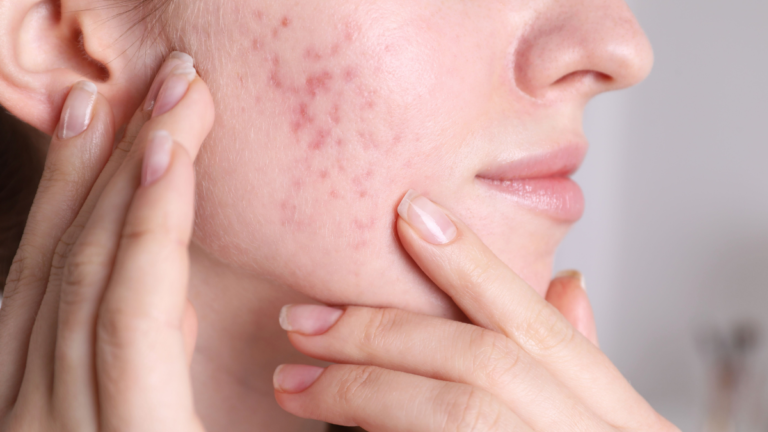

You did not have acne as a teenager. It started in your late twenties, or after a pregnancy, or when you came off the pill. It sits on the chin, the jawline, and the lower cheeks. You have tried benzoyl peroxide, salicylic acid, two rounds of doxycycline, spironolactone, and a prescription retinoid. Every one of them helped a little. Not one of them held. And in between the spots, the skin feels rough, like fine sandpaper, in a way that ordinary acne never did.
If that is your history, there is a specific question that almost nobody asks you: has anyone actually counted the mites?
Quick answer
The relationship between Demodex and hormonal acne is not an either-or. In a study of 108 acne patients and 65 matched controls, Demodex positivity was found in 42.6 percent of acne patients versus 12.3 percent of controls (p < 0.001). On multivariate analysis, Demodex positivity raised the odds of having acne more than fivefold (OR 5.565, 95 percent CI 2.384 to 12.99). The authors specifically concluded that Demodex should be considered when classical acne therapies are ineffective, especially in post-adolescent acne. Hormones drive sebum. Sebum feeds the mite. The two run together rather than competing.
Why Adult Acne and Demodex Get Confused
Because on the face, they can look identical. Both produce inflammatory papules and pustules in a follicular distribution across the lower face. Both flare and settle. Both respond partially to antibiotics.
The differences are real but subtle, and they are easy to miss in a seven-minute appointment.

Signs that point towards Demodex rather than ordinary acne
- Adult onset with no teenage history. The acne that starts at 28 is a different animal from the acne that never left.
- Few or no comedones. Classic acne produces blackheads and whiteheads alongside inflamed lesions. Demodicosis tends to produce papules and pustules with a conspicuous absence of comedones.
- Sandpaper texture between the lesions. Roughness and follicular prominence in the skin that is not actively broken out.
- Background redness. A rosacea-like flush underneath the acne picture.
- The treatment signature. Partial response to everything, durable response to nothing, and a reliable relapse a few weeks after each course ends.
That last one is the most diagnostically useful, and it is the one patients describe most often. If you want to see how this overlaps with other look-alikes, our guide to Demodex on the body covers the fungal acne comparison in detail, and perioral dermatitis and Demodex covers the chin and mouth distribution specifically.
The Evidence: What the Acne Studies Actually Found
The strongest single dataset on Demodex and hormonal acne comes from a study published in Advances in Dermatology and Allergology, which enrolled 108 acne patients and 65 age-matched and sex-matched healthy controls. Every participant had a standardised skin surface biopsy to determine Demodex presence.
Demodex positivity was 42.6 percent in the acne group and 12.3 percent in controls (p < 0.001). More importantly, when the authors ran a multivariate logistic regression to identify which factors independently predicted acne, Demodex positivity came out as the strongest, with an odds ratio of 5.565 (95 percent CI 2.384 to 12.99, p < 0.001).
Their conclusion is quoted almost verbatim in the abstract, and it is the single most actionable sentence in the acne-Demodex literature: Demodex infestation should be considered when the classical therapies are ineffective, especially in cases of post-adolescent acne.
The same study found that alcohol consumption was related to Demodex positivity specifically in the post-adolescent acne group (p = 0.019), which lines up with the alcohol findings in the Demodex and rosacea cohort data.
The Sebum Bridge: How Hormones and Mites Connect
This is the part that resolves the apparent contradiction between a hormonal explanation and a parasitic one.
Demodex mites eat sebum. That is their food supply. Anything that increases sebum output increases the carrying capacity of the follicle for mites.
Androgens (testosterone, DHT, and DHEA-S) drive sebaceous gland growth and sebum production. That is the accepted mechanism behind hormonal acne. What is less often stated is the obvious downstream consequence: a hormonally driven increase in sebum is also a hormonally driven increase in mite food.
So the hormonal picture and the mite picture are not two competing hypotheses. They are two links in the same chain. Hormones build the environment. The mite moves into it. And the inflammation you see in the mirror can be driven by either end.

The Isotretinoin Finding Nobody Talks About
Here is a piece of evidence that reframes how we should think about the acne drug of last resort.
Isotretinoin works, in the standard account, by shrinking the sebaceous gland and dramatically reducing sebum output. In 2025, a prospective study published in the Journal of Cosmetic Dermatology did something nobody had done before: it measured Demodex density in acne and rosacea patients before, during, and after six months of isotretinoin.
Demodex density fell significantly (p < 0.001), and the fall tracked directly with the reduction in sebum secretion. The authors describe it as the first study to assess isotretinoin’s impact on Demodex density.
The implication is worth sitting with. If isotretinoin reduces sebum, and reduced sebum reduces Demodex, then part of what isotretinoin has been doing for four decades may be starving the mite. Nobody was measuring it, so nobody noticed.
This does not mean isotretinoin is an acaricide. It is not. It means the sebum pathway is a real and modifiable lever on mite density, which opens up gentler options than a systemic retinoid for patients who do not need one.
For practitioners
When to suspect Demodex in an acne presentation. Post-adolescent onset, comedone-poor papulopustular morphology, background erythema, follicular scale or sandpaper texture, and a documented history of partial response with predictable relapse across two or more drug classes. The Akcinar cohort found an OR of 5.565 for Demodex positivity in acne on multivariate analysis, which is a stronger independent association than most clinicians assume.
Confirming it. Standardised skin surface biopsy (SSSB) remains the reference bedside method. Dermoscopy showing Demodex tails is supportive. Threshold for pathogenic density is conventionally 5 mites per square centimetre, although the acne literature reports positivity rather than density in most cohorts.
Where it changes management. Antibiotic monotherapy is the common failure mode: it suppresses the inflammatory consequence without touching the mite. In suspected mite-driven acne, an acaricidal agent (topical ivermectin, terpinen-4-ol) alongside sebum modulation is mechanistically coherent, whereas escalating antibiotic duration is not.
Confounder to hold in mind. Demodex positivity in acne cohorts may partly reflect the sebum-rich environment rather than a causal role for the mite. The isotretinoin data cut both ways: they show mite density is sebum-dependent, which is consistent with the mite being a passenger as well as with it being a driver. The clinical test remains whether acaricidal therapy improves outcomes in the treatment-resistant subgroup, and in practice it frequently does.
Why Antibiotics Make It Look Better and Then Worse
This pattern comes up constantly and it has a mechanistic explanation.
Tetracycline antibiotics such as doxycycline and minocycline have genuine anti-inflammatory activity independent of their antibacterial action. They suppress the inflammatory cascade that produces the visible papule. So the skin calms down.
What they do not do is reduce Demodex density. The mite population is untouched. When the antibiotic course finishes, the anti-inflammatory suppression lifts, and the trigger that was never removed fires again.
Patients experience this as “the antibiotics stopped working.” Mechanistically, the antibiotics never addressed the driver in the first place. The same logic applies to the relapse pattern documented in why Demodex rosacea keeps coming back.
What Actually Helps
If mites are contributing to your adult acne, the protocol needs to do two things at once: reduce mite density and reduce the sebum supply that sustains it.
1. Confirm before you commit
Do not self-diagnose from an article. Demodex, fungal folliculitis, and bacterial acne look similar and respond to completely different agents. Get a standardised skin surface biopsy or dermoscopy. See how to test for Demodex mites.
2. Reduce mite density
The evidence-based options are set out in the complete treatment protocol, with topical ivermectin and terpinen-4-ol carrying the strongest data. Expect an initial worsening in the first two to four weeks as mites die; this is the die-off reaction and it is not treatment failure.
3. Address the sebum side
This is where the hormonal workup belongs, and it is legitimate. Androgen excess, insulin resistance, and a high-glycaemic diet all raise sebum output. Reducing sebum reduces the mite’s food supply, which is exactly what the isotretinoin data demonstrate. The gut and metabolic drivers are covered in the Demodex-gut axis and in Demodex and diabetes.
4. Stop the things that feed it
Heavily occlusive, sebum-mimetic oils applied to the face increase the substrate the mite lives on. Give the twelve-week protocol time; the Demodex life cycle is roughly fourteen to eighteen days, and courses shorter than twelve weeks routinely fail to interrupt every generation.
A note on hormones
If you have signs of androgen excess (irregular cycles, hirsutism, scalp thinning, rapid-onset severe acne), that warrants an endocrine workup in its own right, independent of anything on this page. Do not substitute a mite protocol for that assessment.
Further Reading on demodex.net/
- Demodex on the Face: The Complete Guide
- Demodex on the Body: Chest, Back, Torso, or Is It Fungal Acne?
- Demodex and Thyroid Disease: The Hashimoto’s Link
- Perioral Dermatitis and Demodex
- The Complete Demodex Treatment Protocol
- How To Test for Demodex Mites
- Take the Demodex Symptom Quiz
Frequently Asked Questions
Is my acne actually Demodex?
It might be, particularly if it started in adulthood, produces few blackheads, leaves the skin rough between spots, and has partially responded to every treatment you have tried without ever clearing. In one study, 42.6 percent of acne patients were Demodex positive compared with 12.3 percent of controls. Only a standardised skin surface biopsy or dermoscopy can confirm it.
What is the difference between Demodex and hormonal acne?
They are not mutually exclusive, which is the key point. Hormonal acne is driven by androgens increasing sebum production. Demodex mites live on that sebum. A hormonal increase in sebum is also an increase in the mite’s food supply. Many adult patients have both processes running at once, which is why treating only one side gives partial results.
Can Demodex cause cystic acne?
Demodex is more typically associated with papules and pustules than with deep nodulocystic lesions. Severe nodular acne is more likely to be primarily hormonal or bacterial. However, Demodex has been associated with acne severity in cohort data, and mite overgrowth can coexist with cystic disease rather than replacing it as an explanation.
Why does my acne come back every time I stop antibiotics?
Tetracycline antibiotics have anti-inflammatory activity that suppresses the visible lesion without reducing Demodex density. If mites are driving the inflammation, the trigger is still present when you stop the drug, so the papules return. This partial-response-then-relapse pattern is one of the more reliable clues that mites are involved.
Does isotretinoin kill Demodex mites?
Not directly. Isotretinoin is not an acaricide. What a 2025 prospective study showed is that Demodex density falls significantly during isotretinoin treatment (p < 0.001), in step with the reduction in sebum. The mite loses its food supply rather than being killed by the drug.
Can I have Demodex and hormonal acne at the same time?
Yes, and it is common. The two mechanisms reinforce each other through sebum. This is why patients who address only the hormonal side (with spironolactone or oral contraceptives) or only the mite side (with an acaricidal cream) often get an incomplete result, while addressing both tends to hold.
Where does Demodex acne usually appear?
Most often on the cheeks, chin, nasolabial folds, and jawline, following the distribution of the densest sebaceous glands. It can extend to the forehead and, less commonly, the neck. Involvement of the chest and back is less typical and more often points to fungal folliculitis, which is covered in our guide to Demodex on the body.
References
- Akcinar UG, Unal E, Dogruman Al F. Demodex spp. as a possible aetiopathogenic factor of acne and relation with acne severity and type. Postepy Dermatologii i Alergologii. 2018;35(2):174-181. doi:10.5114/ada.2018.75239. PMC5949547
- Chakmakchi M, et al. Therapeutic Modulation of Demodex Density via Isotretinoin: Insights From a Prospective Dermatological Investigation. Journal of Cosmetic Dermatology. 2025. doi:10.1111/jocd.70249. PMC12117431
- Zhao YE, Hu L, Wu LP, Ma JX. A meta-analysis of association between acne vulgaris and Demodex infestation. Journal of Zhejiang University Science B. 2012;13(3):192-202.
- Etiology of Adult Female Acne: A Systematic Review. 2025. PMC12042216
- Lacey N, Russell-Hallinan A, Zouboulis CC, Powell FC. Demodex mites modulate sebocyte immune reaction: possible role in the pathogenesis of rosacea. British Journal of Dermatology. 2018;179(2):420-430.
- Yucel MB, Unal E, Ertas R. Demodicosis and Thyroid Autoimmunity: Unravelling the Connection. Parasite Immunology. 2025;47(7):e70016. PubMed 40659514
- Association Between Demodex Infestation and Severe Acne Vulgaris: A Cross-Sectional Study of 168 Patients. Actas Dermo-Sifiliograficas. 2022. Actas Dermosifiliogr
About the Author
Marina Ivakhnenko is a functional skin practitioner and the editorial lead at demodex.net/, where she develops evidence-based content for patients and practitioners managing Demodex mite overgrowth. Her work draws on peer-reviewed dermatology, endocrinology, and parasitology literature and is reviewed by the demodex.net/ clinical advisory board.
Medical Disclaimer: This article is intended for educational use and does not constitute medical advice. Diagnosis and management of any Demodex-related condition, thyroid disorder, or acne should be carried out under the supervision of a qualified healthcare provider. See the full disclaimer at demodex.net/medical-disclaimer.


