You cut out the red wine. You switched to fragrance-free everything. You got metronidazole from your dermatologist, and for a month your skin was calm. Then the flushing came back. The papules returned. The redness just would not quit.
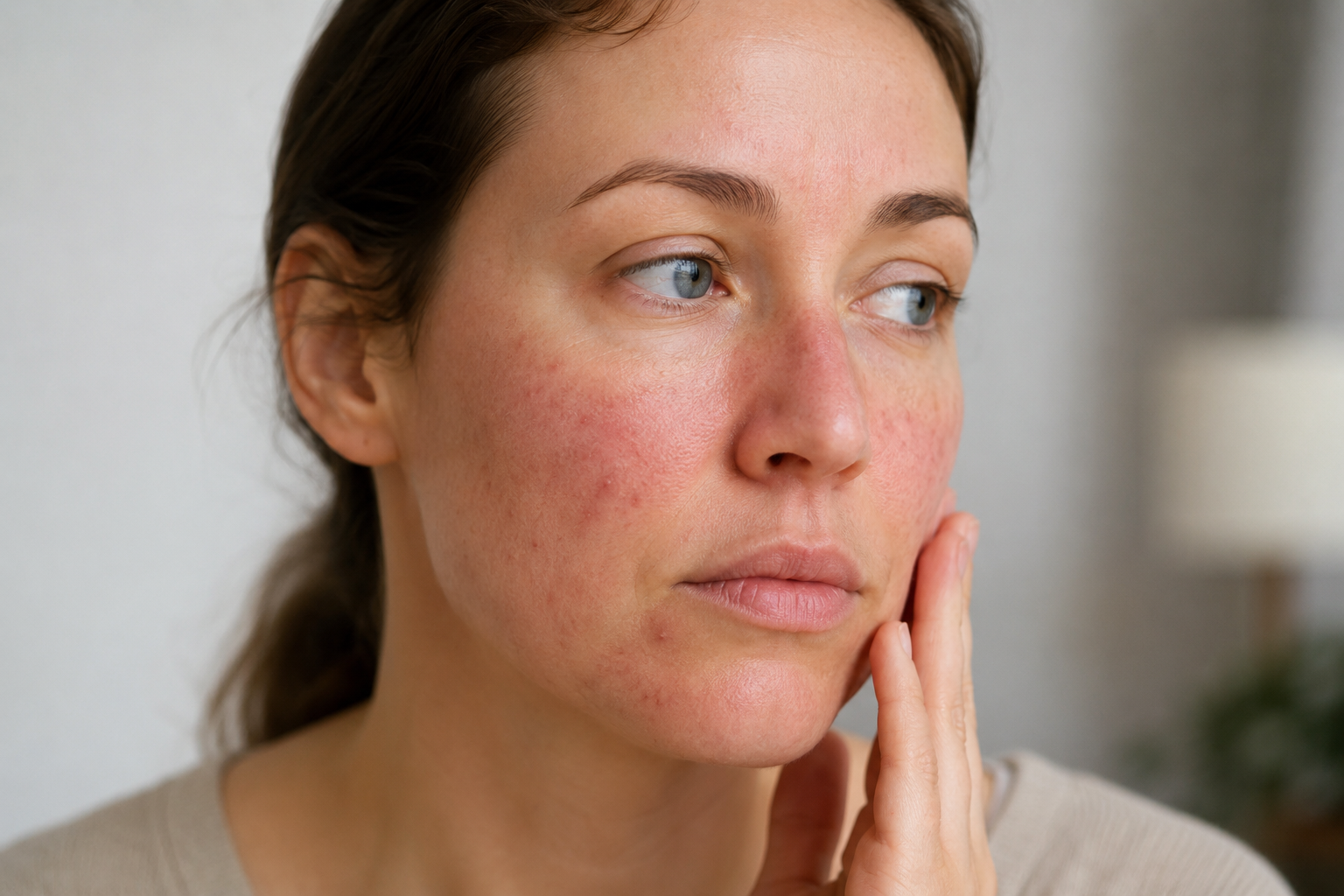
If this sounds familiar, demodex mites rosacea may be the reason. These two conditions feed each other in a loop. Rosacea creates skin where Demodex mites thrive. The mites then make rosacea worse. Most treatments only tackle one side of this loop. That is why so many people keep relapsing.
This guide explains the cycle, the evidence behind breaking it, and the demodex rosacea treatments supported by current evidence.
What Is the Demodex Mites Rosacea Cycle and How Does It Work?
Demodex folliculorum is a tiny mite that lives in your facial hair follicles. All adults carry some Demodex. That is completely normal. The problem starts when the population grows too large.
Here is how the cycle plays out in three steps.
- Step 1: Demodex Mites Rosacea produces inflamed, oily, warm skin and hair loss. That is exactly what Demodex mites need to multiply fast.
- Step 2: Once mite density rises above around 5 mites per square centimeter, the mites carry bacteria on their bodies called Bacillus oleronius. These bacteria activate an immune sensor called TLR2, a mechanism well documented in Demodex research that triggers a wave of inflammatory proteins, including IL-8 and IL-6. The result is more redness, more papules, and more visible blood vessels.
- Step 3: That added inflammation from Demodex Mites Rosaces makes the skin an even better home for Demodex. The mites multiply further. And the loop keeps going.
A 2024 clinical review in Dermatology found that people with Demodex Mites Rosacea carry 10 to 20 times more Demodex mites than people without it, and that mite density correlates directly with symptom severity. A 2026 review in Frontiers in Immunology confirmed this is a two-way relationship where each condition makes the other worse.
Why Does Standard Rosacea Treatment Keep Failing?
Most Demodex Mites Rosacea treatments target either bacteria or blood vessels. Metronidazole fights bacteria. Lasers reduce broken vessels. Ceramide creams restore the skin barrier. These all help with real parts of the problem.
But none of them kill the mites living inside your follicles.
So after Demodex Mites Rosacea treatment, the mite population rebuilds. Inflammation returns. Symptoms relapse. Effective demodex mites rosacea treatment needs to target both the mites and the inflammation at the same time.
Why Does Standard Rosacea Treatment Keep Failing?
There are five evidence-based treatments for demodex mites rosacea. They work best when used in combination fro Demodex Mites Rosacea rather than one at a time.
Does Topical Ivermectin (Soolantra) Actually Work for Demodex Rosacea?
Yes, and it is the most evidence-backed option available. Topical ivermectin 1% cream is FDA-approved for papulopustular rosacea (the type that causes pimple-like bumps on the face). It works two ways.
First, it paralyzes and kills the mites.
Second, it reduces the inflammation of Demodex Mites Rosacea.
A 2025 systematic review of five controlled trials confirmed that topical ivermectin for rosacea or Demodex Mites Rosacea significantly reduced mite density across all studies, with effect sizes beating both vehicle cream and metronidazole. A separate 2025 cohort study found a 78 to 88 percent reduction in rosacea symptoms by week 8 with combination ivermectin therapy.
How to use it: Apply a pea-sized amount to your whole face every night. Continue for 12 to 16 weeks. Do not stop early. Demodex eggs survive most topicals. You need several full mite life cycles (around 14 to 18 days each) to collapse the population.
However, stopping too soon can cause fast rebound of Demodex Mites Rosacea. A 2020 study in Australasian Journal of Dermatology also found topical ivermectin effective for Demodex-related eyelid symptoms that often accompany facial rosacea.
Is Sub-Antimicrobial Doxycycline Worth Taking as a Bridge?
Yes, for most patients it is the fastest way to get initial symptom relief for Demodex Mites Rosacea. Sub-antimicrobial doxycycline (Oracea, 40 mg modified-release) works differently from a standard antibiotic. At this low dose it has no antibiotic effect.
Instead, it suppresses the inflammatory signals, cathelicidin and KLK5 which drive rosacea flares directly. It typically produces visible improvement within 7 to 14 days, bridging the gap while ivermectin is still working to collapse the mite population.
A typical course is 12 weeks. However, it is not appropriate during pregnancy. So, talk to your dermatologist about whether it fits your case.
Can Tea Tree Oil Help Get Rid of Demodex on Your Face?
It can help, with some caveats. Terpinen-4-ol (T4O) is the active compound in tea tree oil that kills Demodex mites. It is also useful around the eyes, where ivermectin cannot safely be applied. Research published in Translational Vision Science and Technology confirmed T4O is the most potent mite-killing ingredient in tea tree oil. However, results across clinical trials have been mixed, so T4O works best as a supporting treatment alongside ivermectin, not a replacement for it.
Use a commercially formulated 5% T4O cleanser. Leave it on for 60 to 90 seconds before rinsing. But, do not apply undiluted tea tree oil directly to skin. Concentrations above 25% can cause irritation, especially on rosacea-prone skin.
What Should You Eat (and Avoid) on a Demodex Rosacea Diet?
Diet directly affects sebum production. Sebum is what Demodex mites feed on. Cutting the food supply is one of the most practical ways to slow mite growth.
Cut out:
- Alcohol, especially red wine and beer
- Refined sugar and high-glycemic carbs like white bread and pastries
- Skimmed milk, which raises IGF-1 (a hormone that drives sebum production)
- Spicy foods during active flare-ups
- Histamine-rich foods like aged cheese, processed meats, and vinegar (if you also get headaches or flushing after eating them)
Add more of:
- Fatty fish, or an omega-3 supplement (2 to 3 g EPA plus DHA per day)
- Leafy vegetables, legumes, and walnuts
- Extra-virgin olive oil
- Cooled green tea (hot drinks are a common rosacea trigger)
A 2023 controlled study of 296 patients published in Nutrients found that high-glycemic diets were linked to worse rosacea and acne severity scores.
Which Supplements Have Evidence Behind Them for Demodex and Rosacea?
These supplements have clinical support for rosacea and Demodex management. They do not replace prescription treatment. They can extend remission by addressing underlying factors.
- Zinc (25 to 50 mg/day as picolinate or bisglycinate): A randomized controlled trial in the International Journal of Dermatology found zinc sulfate improved rosacea severity over 3 months, though a later 2012 trial at a different dose found no significant benefit, so evidence is mixed.
- Omega-3 fatty acids (2 to 3 g EPA plus DHA/day): Reduces vascular inflammation in rosacea skin. It can also improve dry eye symptoms linked to ocular rosacea.
- Multi-strain probiotics:A 2025 narrative review in Biomolecules suggested probiotics may support the immune response involved in Demodex management and reduce redness in rosacea. Look for 20 to 50 billion CFU per day from a multi-strain formula.
- Berberine (500 mg twice daily with food): A 2025 in vitro study in Contact Lens and Anterior Eye found 0.2% berberine effectively inhibited Demodex folliculorum survival, with activity comparable to tea tree oil. Note: this study used ocular Demodex samples; direct evidence in facial rosacea patients is still emerging.
What Does a Simple Treatment Plan for Demodex Rosacea Look Like?
Here is a four-phase approach based on clinical evidence and functional medicine principles. All prescription steps require a licensed dermatologist.
Phase | Weeks | What to Focus On |
1 | 1-2 | Cut trigger foods. Start T4O cleanser and omega-3. Use mineral SPF 30+ every morning. Start sub-antimicrobial doxycycline if prescribed. |
2 | 3-8 | Add topical ivermectin every night. Start zinc, probiotics, and berberine. Replace pillowcases every 48 hours, washed at 60°C or higher. |
3 | 9-10 | Add niacinamide serum for skin barrier repair. Discuss laser with your dermatologist if redness persists. |
4 | 11+ | Maintain with T4O 5 times per week, daily mineral SPF, and long-term supplements. Restart ivermectin at the first sign of relapse. |
Conclusion
Managing demodex mites rosacea is not about finding a single cure. It is about breaking a cycle that standard treatments were never designed to fully address. When mite density goes unchecked, inflammation keeps returning, no matter how carefully you avoid triggers or how consistently you apply metronidazole.
The good news is that the cycle can be broken. Topical ivermectin targets the mites directly. Sub-antimicrobial doxycycline calms the inflammatory signals that drive flares. Dietary changes cut the sebum supply that mites depend on. And supporting supplements help your immune system maintain control long after the active treatment phase ends.
The key with demodex mites rosacea is treating both sides of the loop at once, and staying consistent long enough for the mite population to fully collapse rather than simply retreat and rebuild.
If your rosacea keeps relapsing despite doing everything right, mite overgrowth is very likely part of the reason. A dermatologist can confirm this with a simple in-office skin surface biopsy and help you build a treatment plan that actually holds.
Lasting remission from demodex mites rosacea is possible. It just requires addressing the mites, not only the symptoms they leave behind.
Still Have Questions About Demodex Mites Rosacea?
Does Demodex Cause Rosacea, or Does Rosacea Cause Demodex?
Both feed each other. Rosacea skin helps Demodex grow faster. More Demodex then makes rosacea worse. Treating the mites can often produce clear improvement in rosacea symptoms. This is true even in cases that did not respond well to antibiotics alone.
How Do You Know If Mites Are Driving Your Rosacea?
Look for these signs: papules on the central face that worsen at night, eyelid crusting or irritation, and fast relapse after stopping ivermectin. Also watch for a history of long-term steroid cream use on the face, which suppresses the immune response that controls mite numbers.
A definitive diagnosis of Demodex Mites Rosacea would use a skin surface biopsy. This is a quick in-office test where a dermatologist presses a glass slide against your skin to collect a sample, then counts the mites under a microscope. More than 5 mites per square centimeter generally confirms demodicosis (mite overgrowth).
Why Do People Always Relapse a Few Months After Treatment?
There are usually three reasons. First, the treatment course for Demodex Mites Rosacea was too short to fully collapse the mite population. Second, an underlying factor like gut imbalance, hormonal changes, or chronic stress was never addressed. These factors suppress the immune response that normally keeps mite numbers in check. Third, reinfection sources like pillowcases, face towels, and shared cosmetics were not cleaned. All three need attention for lasting remission.
References
- Wei F, Li L, Kong Y, et al. Evidence for the clinical association between Demodex and rosacea: a review. 2024;240(1):95–102. doi: 10.1159/000534245
- Wang H, Zhou C. Advances in the pathogenesis of rosacea. Front Immunol. 2026;16:1705588. doi: 10.3389/fimmu.2025.1705588 (Published 21 Jan 2026; DOI path reflects submission year 2025.)
- Paichitrojjana A, Khuancharee K, Paichitrojjana A. Efficacy of topical ivermectin in controlling human Demodex infestation: systematic review and meta-analysis. Parasite Epidemiol Control. 2025;e00461. doi: 10.1016/j.parepi.2025.e00461
- Keneshbek Kyzy K, Omurzakova A, Azhikulova V, et al. Safety and effectiveness of combination therapy with 1% ivermectin in moderate to severe rosacea. J Med Microbiol. 2025;74(3):001974. doi: 10.1099/jmm.0.001974 (Previously cited incorrectly as “Edilbekova G” — corrected.)
- Guertler A, Volsky A, Eijkenboom Q, Fiedler T, French LE, Reinholz M. Dietary patterns in acne and rosacea patients. 2023;15(20):4405. doi: 10.3390/nu15204405 (First author is Guertler A, not “Meixner D.”)
- Sharquie KE, Najim RA, Al-Salman HN. Oral zinc sulfate in the treatment of rosacea: a double-blind, placebo-controlled study. Int J Dermatol. 2006;45(7):857–61. doi: 10.1111/j.1365-4632.2006.02944.x
- Manfredini M, Barbieri M, Milandri M, Longo C. Probiotics and diet in rosacea: current evidence and future perspectives. 2025;15(3):411. doi: 10.3390/biom15030411
- Guo S, Wang Y, Li J, et al. In vitro killing effect of berberine and niclosamide on ocular Demodex folliculorum. Cont Lens Anterior Eye. 2025;48(2):102336. doi: 10.1016/j.clae.2024.102336 (Ocular Demodex model; facial rosacea data not available. Previously cited incorrectly as “Li Y, Parasitol Res, 2025.”)
- Tighe S, Gao YY, Tseng SCG. Terpinen-4-ol is the most active ingredient of tea tree oil to kill Demodex mites. Trans Vis Sci Tech. 2013;2(7):2. doi: 10.1167/tvst.2.7.2
- Lacey N, Kavanagh K, Tseng SCG. Under the lash: Demodex mites in human diseases. Biochem (Lond). 2009;31(4):20–24. doi: 10.1042/BIO03104020
- Trave I, Herzberg A. Efficacy of topical ivermectin in treating blepharitis and chalazia associated with Demodex folliculorum. Australas J Dermatol. 2020;61(2):e200–e202. doi: 10.1111/ajd.13207