The creams helped for a while. The antibiotics cleared things up. Then the redness came back. The bumps returned. The eyelid crusting showed up again right on schedule.
Sound familiar? The problem is most likely not on your face.
Everyone has microscopic mites called Demodex living on their skin. In normal numbers they are harmless. When they overpopulate, they trigger rosacea, blepharitis, perioral dermatitis, and a range of skin problems that resist treatment no matter how long you stay on it.
The reason those treatments keep failing comes down to one overlooked connection. Demodex overgrowth is almost never just a skin problem. In most persistent cases, it is driven by what is happening in the gut.
This relationship is known as the demodex–gut axis. When the gut falls out of balance, the skin pays the price. No topical treatment remains effective until that root cause is addressed first.
This article explains exactly how that connection works, how to recognise whether the demodex gut axis is at fault, and the treatment sequence that finally addresses it at its source.
What Is the Demodex–Gut Axis?
Before getting into the connection between the two, let’s understand each term separately.
Demodex mites are tiny parasites that live inside hair follicles and oil glands on the skin. Two species exist in humans. Demodex folliculorum lives in the hair follicles of the face, particularly around the nose, cheeks, and eyelids. Demodex brevis lives deeper, inside the sebaceous glands and the meibomian glands of the eyelids. Both species feed on sebum, which is the natural oil the skin produces.
Having Demodex is normal. Studies estimate that nearly every adult over the age of 60 carries them. The problem only starts when their numbers grow beyond what the immune system can keep in check.
The gut microbiome includes trillions of bacteria, fungi, and other microorganisms that live inside the digestive tract. These microorganisms do far more than digest food. They regulate the immune system, control inflammation throughout the body, and influence how much oil the skin produces.
A landmark 2024 study from Dokuz Eylül University confirmed this connection directly, identifying gut microbiome disruption as a significant and independent risk factor for Demodex-related skin conditions including rosacea, demodicosis, and perioral dermatitis.
The gut–skin axis describes the communication pathway between these two systems. When the gut microbiome is healthy and balanced, it sends anti-inflammatory signals that keep the skin calm. When the gut is disrupted, those signals go wrong. Inflammation rises. Skin oil production increases. And the conditions that allow Demodex to overpopulate fall perfectly into place.
Symptoms: The Skin and Gut Signs Most Doctors Miss Together
Most patients who come in with a Demodex problem have been told it is a skin condition. What they are rarely asked about is what is happening in their gut at the same time.
That is a significant oversight, because the two tend to show up together.
Skin symptoms of Demodex overgrowth
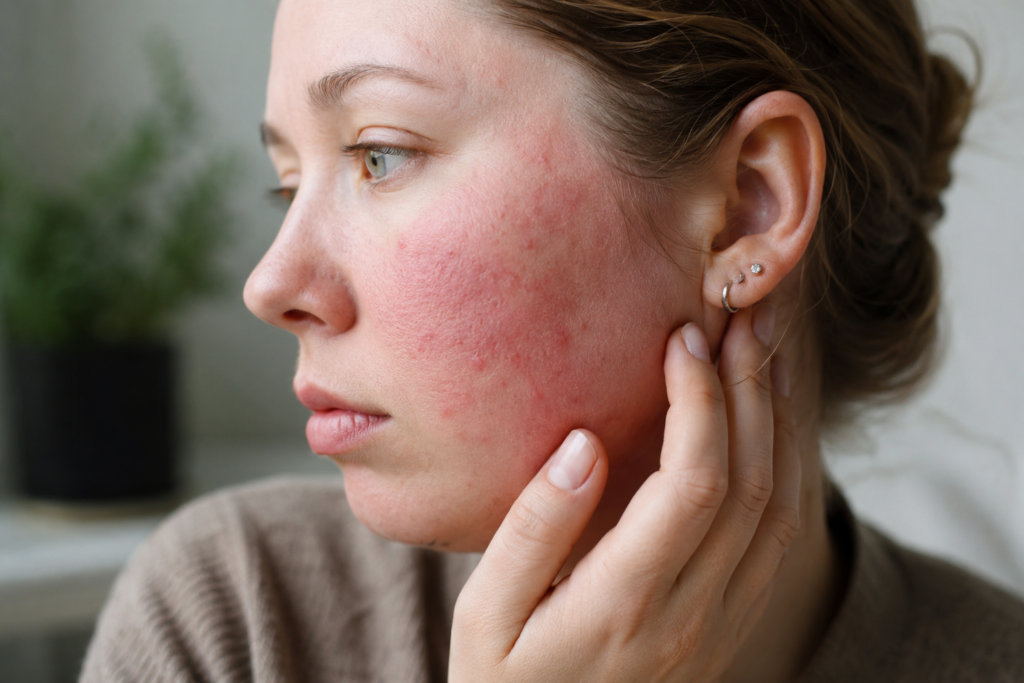
Persistent facial redness across the cheeks, nose, and chin is the most common sign. Papules and pustules tend to flare every two to three weeks, partially settle, then return. That repeating cycle is a diagnostic clue. It matches the Demodex lifecycle almost exactly and is frequently misread as hormonal acne.
Other skin symptoms include eyelid crusting, inflamed eyelid margins, gradual lash loss, and burning or itching that worsens in the evening when mites are most active. Small red bumps around the mouth and nose, known as perioral dermatitis, are also closely associated with Demodex overgrowth.
The clearest sign of all is skin that simply does not respond to standard treatment. Doxycycline and rosacea creams provide partial relief but the mites rebound because nothing has addressed what is allowing them to thrive in the first place.
Gut symptoms that appear alongside
This part rarely gets discussed.
The same 2024 clinical study found that infrequent bowel movements were associated with nearly three times the risk of developing a Demodex-related skin condition.
Many patients with persistent Demodex also report bloating, acid reflux, and bowel habits that alternate between constipation and loose stools. These are classic signs of SIBO.
The most common mistake is treating these as two separate problems. The skin goes to the dermatologist. The gut goes to the gastroenterologist. Nobody connects them.
Root Causes: The Mite–Oil–Microbiome Triangle
Understanding why Demodex overgrows in the first place requires following a chain of events that starts well before anything shows up on the skin.
The gut dysbiosis and leaky gut pathway
When gut bacteria fall out of balance, the intestinal lining gradually becomes more permeable. Many patients know this as a leaky gut.
Once the gut lining is compromised, fragments of bacterial cell walls called LPS pass into the bloodstream. The immune system treats them as a threat and triggers a low-grade inflammatory response throughout the body, including the skin.
That inflammation activates skin receptors called TLR-2, which increases sebum production. More sebum means more food for mites. More food means faster reproduction. The cycle feeds itself.
SIBO as the most common gut root cause
Small intestinal bacterial overgrowth is the gut condition most consistently linked to Demodex-related skin problems.
Research published in the Journal of the American Academy of Dermatology found that SIBO was present in nearly 50 percent of rosacea patients, compared to around 20 percent of healthy controls. More strikingly, patients who received treatment to clear the SIBO saw their rosacea resolve or significantly improve in 64.5 percent of cases, with those results holding at a three-year follow-up. A meta-analysis that pooled 6 studies concluded that the risk of SIBO development in rosacea patients is 3.5 times more than the controls who did not have rosacea.
SIBO allows Demodex to flourish through two mechanisms. First, the bacterial overgrowth suppresses normal immune function. Second, the metabolic byproducts produced by the overgrown bacteria damage the gut lining further, sustaining the leaky gut and LPS pathway described above.
How Demodex amplifies the problem
Demodex mites carry a bacteria called Bacillus oleronius. When mites die inside follicles, they release it directly into surrounding skin tissue, triggering further inflammation. This bacteria is sensitive to several antibiotics commonly used for rosacea, which explains why those antibiotics provide partial relief but never full resolution.
Lifestyle factors
Alcohol has the highest odds of being associated with demodex overgrowth. Smoking, inactivity, low water intake and infrequent bowel movements follow respectively and all are associated with increased risk of demodicosis.
Types of Demodex Overgrowth: Which Species Is Causing Your Problem?
Not all Demodex cases are the same. There are two species, and they cause different problems in different places.
Demodex folliculorum lives in hair follicles on the face. It causes facial redness, papules, pustules, and flushing. This is the species most directly linked to gut dysbiosis, which means gut-focused treatment works well against it.
Demodex brevis lives deeper, inside the oil glands and eyelid glands. It causes dry eye, blepharitis, and ocular rosacea. Because it sits deeper in the tissue, it is harder to treat and takes longer to clear.
The distinction matters because the treatment approach is different for each. Eyelid symptoms point to D. brevis. Facial redness and breakouts point to D. folliculorum. Many patients have both.
How is Demodex diagnosed?
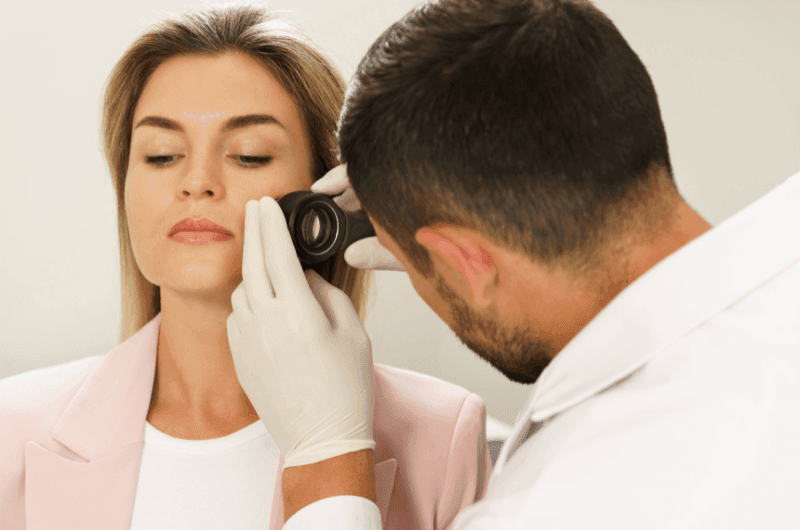
Three methods are commonly used. A skin surface biopsy collects follicle contents for microscopic examination. Dermoscopy lets a doctor see the characteristic plugging pattern on the skin surface without any invasive sampling. HD-OCT is the most advanced option, showing live mites inside follicles in real time with no skin contact needed at all. It is used to track real time progress to treatment.
Treatment Approach: Why Lifecycle Timing Changes Everything
This is where most treatment plans go wrong.
The majority of approaches to Demodex focus entirely on the skin. A topical cream is prescribed, it reduces the mite population for a while, and when it is stopped the mites return within weeks. The patient is told to use it indefinitely. The gut is never mentioned.
A three-phase approach should be followed that works with the biology for getting lasting results..
Understanding the 14 to 18 day mite lifecycle
A Demodex mite passes through four stages in its life starting from an egg into a larva, then a nymph, and finally adult. This complete life cycle can take 14 to 18 days.
Most antiparasitic treatments are effective only against adult mites. In case of a single course of treatment, the eggs and nymphs survive, mature over the following two weeks, and the population recovers to where it started. This is why a single round of treatment almost always leads to relapse.
Phase one: fix the gut first
Before any skin treatment is started, the gut needs to be assessed. Skipping this step is the single most common reason treatment fails.
A breath test for SIBO is the appropriate starting investigation. If SIBO is confirmed, it is treated with rifaximin as the first-line antibiotic, which targets the small intestine specifically without significantly disrupting the large intestinal microbiome.
Until the gut is stabilised, topical and systemic mite treatments provide only temporary results. The dysbiosis continues to drive sebum overproduction and immune suppression, and the mites return regardless of what is applied to the skin.
Phase two: systemic mite treatment timed to the lifecycle
Once the gut treatment begins, add oral ivermectin to address the systemic mite population. It is suggested to take ivermectin in two doses separated by 14 to 18 days. The first dose targets the current adult population while the second dose is to catch the nymphs that have matured into adults. For milder presentations, topical ivermectin alone may be sufficient when applied consistently and for an adequate duration.
Phase three: topical maintenance and barrier support
Phase three runs alongside phase two and continues after it.
Topical ivermectin kills mites directly and also reduces the inflammation. It is approved for Demodex folliculorum infection treatment. Metronidazole is often used alongside or as an alternative to remove Bacillus oleronius, the bacteria that mites carry and release into follicles.
For patients with ocular Demodicosis and eyelid involvement, tea tree oil-based eyelid cleansers are effective and generally well-tolerated.
The probiotic adjunct
Probiotics help strengthen the gut in that fight against demodex. A 2025 study concluded that a topical Vitreoscilla filiformis probiotics may reduce Demodex mite density and eyelid swelling in treated patients. The effectiveness of probiotics in demodex eradication is still under research but the early results are promising.
Diet and Lifestyle: Starving Mites From the Inside Out
Treatment does the heavy lifting. What you eat and how you live either supports that work or quietly undoes it.
Foods to reduce Demodex mite activity
Mites eat sebum. So the goal is producing less of it.
Sugar and refined carbs push up a hormone that tells oil glands to work harder. Cut those down and sebum production follows. Eat simple things like vegetables, whole grains and fruits. Nothing complicated.
Fermented foods like yoghurt help the gut bacteria to regrow while garlic and oats then keep those bacteria healthy. One restocks the gut, the other maintains it.
Salmon and sardines a few times a week bring omega-3 fats that slowly reduce the background inflammation driving the whole cycle.
None of this replaces treatment. But patients who eat this way during treatment tend to hold their results. Those who go back to old habits tend not to.
Hydration, exercise, and sleep
The 2024 clinical study found that drinking less than one litre of water per day has thrice the odds for Demodex-related conditions, and physical inactivity quadruples the odds. Both affect gut motility. When the gut moves slowly, bacteria stagnate in the small intestine and SIBO develops. Two litres of water daily and thirty minutes of moderate exercise five times a week address both risk factors at once.
Chronic sleep deprivation and unmanaged stress raise cortisol, which drives up sebum production and suppresses the immune response. Sleep and stress management are not optional; rather they are part of the treatment.
What to Avoid: The Triggers That Feed Mites and Damage Your Gut at the Same Time
The most common Demodex triggers are also the ones that damage the gut microbiome. That overlap reflects the same underlying biology.
Alcohol has the highest odds of association with demodex infection in the 2024 study. It disturbs the gut bacterial microbiome, causes skin vessels to dilate, and alters sebum composition. Even moderate regular consumption works against treatment.
Oleic acid-rich facial oils like coconut, olive, rosehip, and marula oils are high in oleic acid. Demodex feasts on it. Applying these oils around the nose, cheeks, and eyelids provides a direct food source. Avoid oil-based facial products during the time of treatment to remove the favorable factors for the parasite reproduction.
Broad-spectrum antibiotics without probiotic support kill Lactobacillus and other helpful variants of gut microbiome. Prolonged use of antibiotics without concurrent probiotics often creates a pattern where the skin improves briefly and then worsens again. When antibiotics are necessary, take a quality probiotic several hours apart from each dose.
Shared makeup tools are an overlooked transmission route. Studies confirm Demodex survives in mascara, lipstick, and powder for several hours, long enough to transfer between hosts.
High-heat environments like saunas and steam rooms drive mites toward the skin surface and are associated with flares during active treatment.
Chronic NSAID use disturbs the intestinal epithelium, adding to the leaky gut burden that drives the demodex–gut cycle.