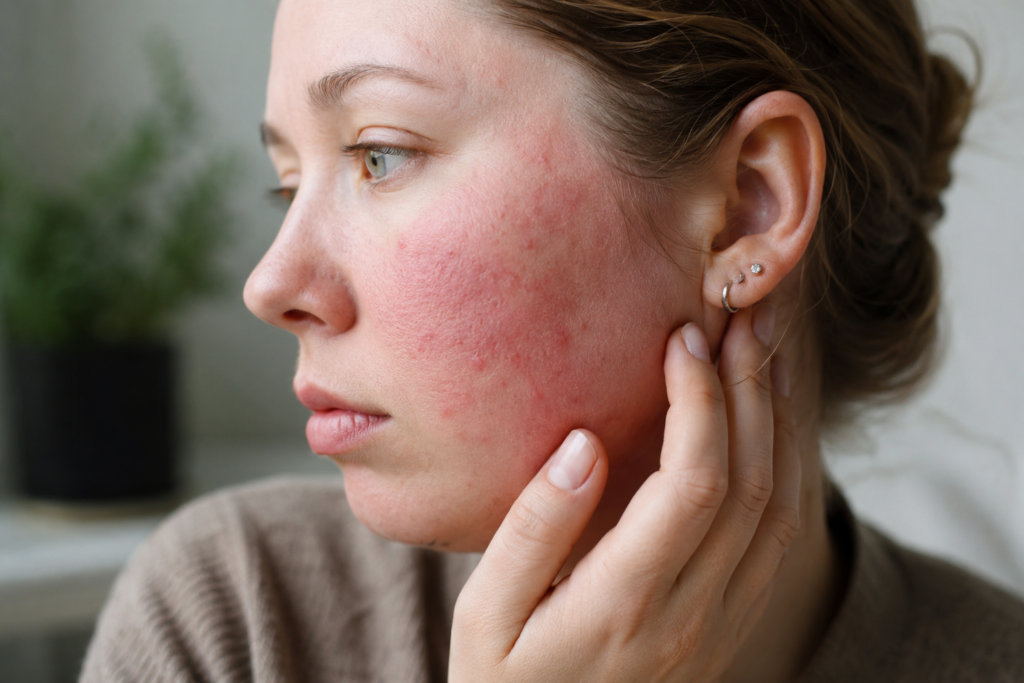
The eyelid wipes worked for six weeks. The flushing eased. The morning crusting at the lash line cleared. Then the patient stopped because the bottle ran out, or because the burning was uncomfortable, or because a friend warned that pure tea tree oil “is too harsh for skin.” Within twelve days the lash collarettes returned. The cheeks reddened again. The follicular bumps re-emerged in exactly the same pattern as before.
This sequence is the most common clinical story in Demodex care, and it is almost always a story about tea tree oil used incorrectly. The molecule that kills the mite is right; the concentration, the duration, or the form is wrong. This guide is the complete clinical evidence base for using tea tree oil for Demodex the way it actually works.
Why Tea Tree Oil Works on Demodex: The Biology Behind the Molecule
Tea tree oil is the essential oil distilled from the Australian shrub Melaleuca alternifolia. The oil is a complex mixture of more than one hundred compounds, but a single one of these does the clinical work against Demodex: terpinen-4-ol, often written as T4O. The international standard ISO 4730 defines genuine tea tree oil as containing 30 to 48 percent terpinen-4-ol and less than 15 percent 1,8-cineole, the compound responsible for most of the irritation that gives raw tea tree oil its reputation.
Terpinen-4-ol kills Demodex through several mechanisms working in parallel. It disrupts the lipid bilayer of the mite’s cell membrane, causing osmotic collapse. It interferes with the cuticular wax layer that protects the adult mite from desiccation. It produces a direct neurotoxic effect through interference with octopamine signalling, the invertebrate equivalent of adrenergic transmission. Within thirty minutes of exposure to a sufficient concentration, adult Demodex folliculorum and Demodex brevis stop moving, shrink, and die.
The eggs are the problem. Demodex eggs are coated in a thick chitinous shell that terpinen-4-ol penetrates poorly. A single treatment course kills the adult mites but leaves the next generation intact. This is the fundamental reason why Demodex treatment relapses so reliably at the four to six week mark in patients who stop early.

The Dual-Mechanism Framework for Tea Tree Oil Therapy
A common clinical error is treating tea tree oil as a one-step solution. It is not. Effective use of tea tree oil for Demodex requires that two mechanisms be addressed at the same time.
Required Mechanisms for Sustained Response
- Acaricidal kill of the adult mite. This is the role of terpinen-4-ol applied at the correct concentration to the affected anatomic site. Facial skin and the eyelid margin require different formulations.
- Disruption of the mite reproductive cycle. Because the eggs are largely resistant to T4O, protocols must continue for long enough to catch each newly hatched cohort as it matures. This is why a single two-week course produces a temporary effect followed by recurrence.
The five evidence-based tea tree oil protocols described below are organised by anatomic site and clinical severity. Each addresses both mechanisms when applied as written.
The Five Evidence-Based Tea Tree Oil Protocols for Demodex
01. Standardised Terpinen-4-ol Eyelid Wipes — First Line for Demodex Blepharitis
Indication. Anterior blepharitis with cylindrical collarettes at the lash base, recurrent styes, eyelid grittiness, or chronic dry eye where Demodex has been confirmed or strongly suspected.
Mechanism. Commercial wipes are standardised to either pure terpinen-4-ol (typical concentrations 2.5 to 38 percent) or to a tea tree oil base with a known T4O content. Because the wipe delivers the molecule in a controlled, low-volume vehicle directly to the lash root, the local concentration on the eyelid margin is sufficient to kill mites without the irritation that liquid preparations produce.
Clinical protocol.
- Apply once or twice daily across the upper and lower eyelid margins, including the lash root, for a minimum of eight weeks.
- Maintain at three to four times weekly for a further four to eight weeks to interrupt subsequent generations.
- In moderate to severe presentations, combine with monthly in-office deep eyelid cleaning by an eye care provider.
Evidence summary. A 2024 randomised open-label trial published in Translational Vision Science and Technology compared T4O wipes alone with T4O wipes plus structured deep cleaning over a two-month period. The combination group achieved approximately twofold greater reduction in Demodex load and significantly greater improvement in Ocular Surface Disease Index scores than wipes alone. A 2021 meta-analysis in Contact Lens and Anterior Eye pooling multiple controlled studies confirmed that tea tree oil derivatives outperform mechanical lid hygiene, baby shampoo, and povidone-iodine for Demodex blepharitis.
02. Diluted Tea Tree Oil Facial Application — Daily Maintenance for Facial Demodicosis
Indication. Persistent central facial erythema, follicular plugging, sandpaper texture, or papulopustular rosacea where elevated Demodex density has been confirmed or suspected.
Mechanism. A 2 to 5 percent dilution of standardised tea tree oil in a non-comedogenic carrier delivers enough terpinen-4-ol to suppress mite density at the follicular opening without compromising the epidermal barrier. The carrier choice is clinically important. Oleic-acid-rich oils, including olive oil, rosehip oil, and marula oil, can paradoxically feed Demodex by supplementing their preferred lipid substrate. Acceptable carriers include fractionated coconut oil (caprylic and capric triglycerides), jojoba esters, and pharmaceutical-grade mineral oil.
Clinical protocol.
- Begin at 2 percent dilution for one week to establish tolerance.
- If tolerated, advance to 5 percent.
- Apply each evening after a fragrance-free cleanser and before a ceramide-rich emollient.
- Continue for a minimum of twelve weeks.
- Do not apply within 1 centimetre of the eye margin; for periocular use, switch to a commercial T4O wipe formulation.
Evidence summary. Gao and colleagues demonstrated in Cornea that daily 5 percent tea tree oil ointment produced symptom resolution and measurable Demodex count reduction. A 2025 systematic review pooling six randomised controlled trials confirmed non-inferiority of dilute tea tree oil preparations to topical metronidazole for papulopustular rosacea associated with Demodex.

03. Compounded 5 Percent Tea Tree Oil Cream — Intensive Site-Specific Care
Indication. Localised demodicosis presenting as a recalcitrant patch of papules, follicular pustulation, or pityriasis folliculorum that has not responded to lower-strength approaches.
Mechanism. Compounding pharmacies can prepare a 5 percent tea tree oil cream in a fragrance-free cream base. The cream vehicle gives longer skin contact time than a liquid dilution, increasing cumulative T4O exposure to the follicular environment.
Clinical protocol.
- Apply a thin film twice daily for four to six weeks.
- Step down to once daily for a further four weeks once erythema and pustulation have settled.
- Pair with a fragrance-free emollient at the opposite end of the day to maintain barrier integrity.
Evidence summary. Compounded preparations have a long dermatologic track record. Reported clinical response rates from case series exceed 70 percent for symptomatic improvement at six weeks, with the caveat that compounded products vary in stability and exact T4O content. Patients should be advised to use freshly compounded preparations and to store away from heat and light.
04. In-Office 50 Percent Tea Tree Oil Lid Scrub — Practitioner-Administered Intensive Therapy
Indication. Moderate to severe Demodex blepharitis, refractory ocular demodicosis, or high collarette burden where rapid mite load reduction is clinically indicated.
Mechanism. At 50 percent concentration, tea tree oil reliably kills adult Demodex on contact. This concentration is too irritating for unsupervised home use, so it is delivered in a clinic setting after topical anaesthesia, typically by an ophthalmologist, optometrist, or dermatologist trained in the technique.
Clinical protocol (practitioner administered).
- One drop of topical anaesthetic to each eye.
- Application of 50 percent tea tree oil (commonly in a macadamia nut oil base) to the lash margin with a cotton-tipped applicator.
- Three applications ten minutes apart per visit.
- Three visits at one week intervals, then re-evaluation.
- Followed at home by a 5 percent tea tree oil cream or commercial T4O wipe for maintenance.
Evidence summary. Gao and colleagues established the original 50 percent in-office protocol in Cornea, documenting clearance of cylindrical collarettes and resolution of symptoms in patients refractory to other approaches. This remains the most rapidly acting non-prescription approach to Demodex blepharitis and is referenced in expert panel consensus documents including the DEPTH panel published in Eye.
05. Tea Tree Oil Combined With Adjunct Therapy — The Synergy Protocols
Indication. Patients with mixed presentations (skin plus eyelid), patients with high mite burden, patients with significant inflammatory component, or any patient who has failed monotherapy.
Mechanism. Tea tree oil works in synergy with several other agents that target complementary aspects of the Demodex pathology. Hypochlorous acid sprays reduce surface bacterial co-pathogen load and lower local inflammation. Green tea extract (EGCG) modulates the immune response without itself being acaricidal. Manuka honey (UMF 10+) targets Bacillus oleronius, the gram-negative bacterium released when mites die in situ. Topical ivermectin acts through a completely independent acaricidal mechanism (chloride channel paralysis) and provides additive kill.
Clinical protocol (combination examples).
- Skin plus eye combination. 5 percent tea tree oil cream on facial skin in the evening, T4O wipes on the eyelid margin morning and evening, hypochlorous acid spray on both areas after cleansing.
- Severe rosacea-Demodex overlap. Dilute tea tree oil evening application alternating with topical ivermectin under dermatologist supervision, oral green tea extract 200 to 400 mg daily.
- Refractory blepharitis. In-office 50 percent tea tree oil intensification, followed by daily T4O wipes plus prescription lotilaner ophthalmic solution (Xdemvy) under ophthalmologist supervision.
Evidence summary. Combination protocols are increasingly the standard of care for moderate to severe Demodex presentations. The DEPTH expert consensus on Demodex blepharitis explicitly endorses combination approaches over any single intervention for symptomatic patients. Combination data also support reduced relapse rates compared with single-agent approaches over a twelve-month follow-up.
The Structured 12-Week Tea Tree Oil Protocol
The single most common reason a tea tree oil protocol fails is inadequate duration. The Demodex life cycle is fourteen to eighteen days from egg to reproductive adult. A two-week course of any acaricidal agent kills the current adult population and is then followed, two to three weeks later, by a rebound from surviving eggs. The structured four-phase protocol below addresses this biology.
Phase 1 — Weeks 1 and 2: Barrier Stabilisation
Begin with a fragrance-free, pH-balanced cleanser, a soothing serum (green tea extract or niacinamide), and a ceramide-rich emollient morning and evening. Discontinue retinoids, high-percentage chemical exfoliants, and oleic-acid-rich facial oils. The aim is to settle baseline inflammation and restore barrier function so that the acaricidal phase is tolerable.
Phase 2 — Weeks 3 to 8: Active Acaricidal Phase
Morning: gentle cleanser, soothing serum, broad-spectrum SPF moisturiser. Evening: gentle cleanser, 2 to 5 percent dilute tea tree oil to facial skin, T4O wipes to eyelid margin if blepharitis is present, ceramide emollient over the top. Nightly application is essential. Demodex mite activity peaks between 22:00 and 04:00, so evening dosing puts the maximum acaricidal concentration on the skin at the moment of peak vulnerability.
Phase 3 — Weeks 8 to 12: Intensification
For responders, maintain the Phase 2 routine. For slow responders, add Manuka honey UMF 10+ twice weekly to address bacterial co-pathogen load, alternate evening application of tea tree oil with neem oil (1 to 3 percent), and consider an in-office 50 percent T4O lid scrub for blepharitis cases. Continue oral green tea extract throughout for systemic immune support.
Phase 4 — Week 12 Onward: Maintenance and Relapse Prevention
Step down active tea tree oil application to two or three times weekly once symptoms are quiescent. Maintain barrier support indefinitely. Reinstate the full Phase 2 routine at the first sign of recurrence (typically returning collarettes, fresh follicular pustulation, or the characteristic evening pruritus). For patients with a history of recurrent demodicosis, twice weekly maintenance is generally continued for twelve months.
Why Tea Tree Oil Alone Is Not Enough: The Systemic Cofactors
Tea tree oil is a powerful local therapy. It is not, on its own, a complete solution. Patients who relapse after a well-executed topical protocol almost always have unaddressed systemic drivers that returned the immune system to the dysregulated state that allowed overgrowth in the first place.
The Demodex-gut axis is the most consistently identified systemic driver of recurrent overgrowth. Gut dysbiosis and small intestinal bacterial overgrowth (SIBO) increase intestinal permeability, allowing bacterial lipopolysaccharide (LPS) fragments to enter the bloodstream. The resulting innate immune activation increases sebum production through TLR-2 signalling, expanding the primary Demodex nutrient substrate, while simultaneously suppressing the regulatory T cell populations that normally keep mite density in check. A 2013 study in the Journal of the American Academy of Dermatology reported SIBO in 46 percent of rosacea patients versus 5 percent of controls, and rifaximin-based SIBO treatment produced marked rosacea improvement in 46 percent of treated cases.
A 2024 cross-sectional clinical study identified several modifiable lifestyle variables strongly associated with Demodex-related dermatoses:
- Alcohol consumption: odds ratio 11.13 — the single strongest modifiable risk factor identified.
- Physical inactivity (under 1 hour per week): significantly elevated risk through gut motility impairment and immune dysregulation.
- Low water intake (under 1 litre daily): independently associated with tripled risk.
- Infrequent bowel movements (3 or fewer per week): 2.71-fold increased risk, consistent with the SIBO-demodicosis association.
- Chronic sleep impairment: reduces nocturnal cortisol regulation and impairs immune Treg function.
Further Reading on demodex.net/
- Natural Remedies for Demodex Mites: A Clinical Evidence Review
- The Demodex-Gut Axis: Why Skin Mites Are a Gut Health Problem
- Demodex Research Library: Peer-Reviewed Evidence
- Clinical Assessment: Demodex Density Screening Tool
- Demodex Blepharitis: Complete Patient and Practitioner Resources
- Find a Demodex-Aware Practitioner Near You
Frequently Asked Questions About Tea Tree Oil for Demodex
What concentration of tea tree oil kills Demodex mites?
For complete in vitro kill of adult Demodex on the eyelid margin, the active compound terpinen-4-ol must reach 50 percent or greater concentration. For daily home use on facial skin, a 2 to 5 percent dilution of standardised tea tree oil in a non-comedogenic carrier is the evidence-based standard. Lower concentrations may suppress mite density but rarely eradicate the population, and higher concentrations applied unsupervised typically cause irritant contact dermatitis and stop the patient from completing the course.
Can I use 100 percent tea tree oil directly on my skin?
No. Undiluted tea tree oil reliably causes irritant contact dermatitis, eczematous reactions, and disruption of the epidermal barrier. Pure tea tree oil applied directly to the face or eyelid often makes Demodex symptoms worse over the short term and prevents completion of the twelve-week protocol that is required for actual resolution. Dilution to 2 to 5 percent for facial use, or use of a standardised commercial T4O wipe for eyelids, is the correct approach.
How long does it take for tea tree oil to clear Demodex?
Symptomatic improvement, particularly reduced nocturnal pruritus and lid margin grittiness, is typically observed within two to four weeks. Clinically significant Demodex density reduction is documented at six to eight weeks. A minimum twelve-week protocol is required to interrupt multiple generations of the 14 to 18 day Demodex life cycle and reduce the risk of repopulation from surviving immature forms.
Is tea tree oil safe around the eyes?
Liquid tea tree oil should not be applied directly into the eye or to the conjunctiva, because it causes significant burning and surface toxicity. Standardised terpinen-4-ol eyelid wipes are formulated specifically for periocular use and have been extensively studied in randomised trials for Demodex blepharitis. In-office 50 percent tea tree oil application is also safe when performed by a trained ophthalmologist or optometrist under topical anaesthesia. Home use of liquid tea tree oil dilutions on the eyelid margin without professional supervision is not recommended.
What is the difference between tea tree oil and terpinen-4-ol?
Tea tree oil is the whole essential oil distilled from Melaleuca alternifolia. It contains more than one hundred compounds. Terpinen-4-ol is the single active compound within tea tree oil that is responsible for the acaricidal effect on Demodex. Commercial T4O wipes contain isolated terpinen-4-ol at a known concentration, which makes dosing predictable and removes most of the irritating 1,8-cineole that gives raw tea tree oil its harsh reputation. For periocular use, standardised T4O products are clinically preferred over raw tea tree oil dilutions.
Why do my Demodex symptoms return after I stop tea tree oil?
Three causes account for almost all relapse. First, treatment duration was too short and the next generation of mites hatched from eggs that the previous course did not penetrate. Second, the systemic drivers of overgrowth (gut dysbiosis, SIBO, alcohol use, chronic sleep impairment, stress) remained unaddressed and re-established the immune environment that originally allowed overgrowth. Third, household reinfection from shared pillowcases, towels, or makeup applicators reintroduced mites onto cleared skin. Addressing all three layers is what separates patients who clear and stay clear from patients who cycle through repeated relapses.
Can tea tree oil cure rosacea?
Tea tree oil does not cure rosacea as a disease entity, because rosacea is a chronic inflammatory condition with multiple drivers including vascular dysregulation, neurogenic inflammation, and microbiome imbalance. Tea tree oil does, however, address the Demodex component that is now recognised as a major contributor to papulopustular rosacea. Patients whose rosacea is being driven primarily by elevated Demodex density often experience substantial symptomatic improvement when tea tree oil is added to their regimen. Patients whose rosacea is being driven by other mechanisms benefit less.
Can I use tea tree oil for Demodex on my scalp?
Yes. Tea tree oil shampoos at 2 to 5 percent concentration are an evidence-supported component of Demodex-related scalp folliculitis and scalp pruritus management. The shampoo should be left on the scalp for three to five minutes before rinsing to allow adequate contact time. Use three to four times weekly during active treatment, stepping down to twice weekly for maintenance. Patients with scalp Demodex should also be assessed for facial and eyelid involvement, since the same patient population is frequently affected at multiple sites.
References and Evidence Sources
- Wang HY, Shen D, Qi MY, et al. Efficacy of terpinen-4-ol combined with eyelid deep cleaning for the treatment of Demodex blepharitis: a randomized, open-label trial. Translational Vision Science and Technology. 2024;13(11):22.
- Tighe S, Gao YY, Tseng SCG. Terpinen-4-ol is the most active ingredient of tea tree oil to kill Demodex mites. Translational Vision Science and Technology. 2013;2(7):2.
- Ayres BD, Donnenfeld E, Farid M, et al. Clinical diagnosis and management of Demodex blepharitis: the Demodex Expert Panel on Treatment and Eyelid Health (DEPTH). Eye. 2023;37:3249-3255.
- Navel V, Mulliez A, Benoist d’Azy C, et al. Efficacy of treatments for Demodex blepharitis: a systematic review and meta-analysis. The Ocular Surface. 2019;17(4):655-669.
- Gonzalez-Salinas R, Karpecki P, Yeu E, et al. Safety and efficacy of lotilaner ophthalmic solution 0.25% for the treatment of Demodex blepharitis: pooled analysis of two pivotal trials. Ophthalmology and Therapy. 2025;14(3):555-571.
- Forton FMN, De Maertelaer V. Two consecutive standardized skin surface biopsies: an improved sampling method to evaluate Demodex density. Acta Dermato-Venereologica. 2025;105:adv12345.
- Paichitrojjana A, Chalermchai T. Efficacy of topical ivermectin in controlling human Demodex infestation: a systematic review. Clinical, Cosmetic and Investigational Dermatology. 2025;18:33-47.
- Gao YY, Di Pascuale MA, Li W, et al. In vitro and in vivo killing of ocular Demodex by tea tree oil. British Journal of Ophthalmology. 2005;89(11):1468-1473.
- Garcia-Garcia R, Pinheiro MN, Pinheiro FI, et al. Interventions for Demodex blepharitis and their effectiveness: a systematic review and meta-analysis. Contact Lens and Anterior Eye. 2021;44(5):101453.
- Basol I, Yazisiz H, Ilhan HD, et al. Efficacy of cyclic terpinen-4-ol therapy for Demodex blepharitis. Indian Journal of Ophthalmology. 2025;73(4):603-609.
- Weiss E, Katta R. Diet and rosacea: the role of dietary change in the management of rosacea. Dermatology Practical and Conceptual. 2017;7(4):31-37.
- Parodi A, Paolino S, Greco A, et al. Small intestinal bacterial overgrowth in rosacea: clinical effectiveness of its eradication. Clinical Gastroenterology and Hepatology. 2008;6(7):759-764.
- Forton FMN. Papulopustular rosacea, skin immunity and Demodex: pityriasis folliculorum as a missing link. Journal of the European Academy of Dermatology and Venereology. 2012;26(1):19-28.
- Lacey N, Russell-Hallinan A, Powell FC. Study of Demodex mites: challenges and solutions. Journal of the European Academy of Dermatology and Venereology. 2024;38(2):245-255.
- Hu L, Zhao Y, Niu D, et al. Efficacy and safety of topical 1% ivermectin cream in the treatment of Demodex blepharitis: a randomized controlled trial. Cornea. 2022;41(4):444-450.
About the Author
Marina Ivakhnenko is a clinical writer and editorial lead at demodex.net/, where she develops evidence-based content for patients and practitioners managing Demodex mite overgrowth. Her work draws from peer-reviewed dermatology, ophthalmology, and parasitology literature and is reviewed by the demodex.net/ clinical advisory board. Marina specialises in translating complex parasitology and skin immunology research into clear, clinically actionable guidance.